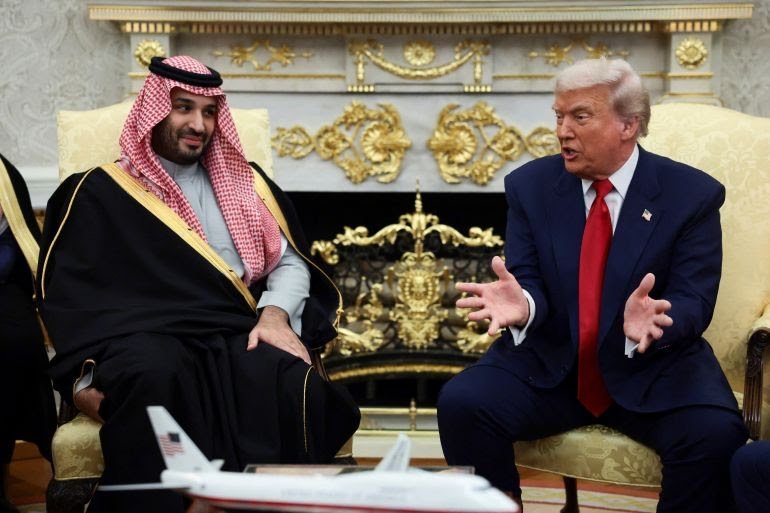
In a display of pomp and pragmatism that harkened back to the opulent diplomacy of yesteryear, President Donald Trump rolled out the red carpet—literally—for Saudi Crown Prince Mohammed bin Salman (MBS) at the White House on November 18, 2025. Amidst a procession of horses, blaring military brass bands, and a roaring flyover by F-35 jets, the two leaders sealed a whirlwind of deals that underscore a bold recalibration of America’s alliances in the Middle East. This wasn’t just a state visit; it was a high-stakes auction of influence, where petrodollars met political theater, signaling the dawn of a transactional era in global power plays.
The optics were unmistakable: Trump, fresh off his 2024 electoral triumph, positioned himself as the ultimate dealmaker, while MBS, the 40-year-old architect of Saudi Arabia’s Vision 2030 reforms, sought to burnish Riyadh’s image as an indispensable partner. But beneath the spectacle lies a deeper narrative—one of economic interdependence, strategic hedging, and the quiet rewriting of the post-Cold War order. As the dust settles on this landmark encounter, let’s unpack the visit’s highlights and what it portends for the world stage.
A Ceremonial Spectacle with Substantive Stakes
The day’s agenda kicked off with a South Lawn arrival ceremony that could rival a Hollywood blockbuster. “We’re honoring Saudi Arabia,” Trump declared as he personally greeted MBS, dubbing him a “good friend” and “visionary leader” in effusive remarks that glossed over past frictions, according to CBS News. The Saudi prince, in turn, delivered a concise White House address emphasizing mutual prosperity and security, flanked by U.S. and Saudi flags fluttering in the crisp autumn air. Notably absent from the pomp? Any mention of Jamal Khashoggi, the Washington Post columnist whose 2018 murder in Istanbul’s Saudi consulate cast a long shadow over bilateral ties. Trump dismissed lingering U.S. intelligence assessments implicating MBS as “fake news” from a bygone administration, shrugging off the controversy with a blunt “Things happen. But he knew nothing about it,” Reuters reported. That line drew cheers from his base but groans from human rights advocates, with MBS himself acknowledging the pain: “It’s painful and it’s a huge mistake, and we are doing our best that this doesn’t happen again,” as covered by The Guardian.
Private bilateral talks, followed by a working lunch and state dinner, delved into thorny issues: regional stability, energy markets, and countering Iran’s influence. Even soccer icon Cristiano Ronaldo, a star in Saudi’s Al-Nassr club and a symbol of the kingdom’s soft-power push, made a cameo, blending sports diplomacy with high-stakes geopolitics, per The Athletic. On X (formerly Twitter), reactions ranged from triumphant posts hailing Trump’s “winning” streak—“Pres. Trump rolls out the red carpet for MBS at White House dinner,” beamed Breaking911—to scathing critiques labeling the affair a “corruption syndicate” redux, with echoes of Jared Kushner’s post-White House windfalls from Saudi investors.
Deals on the Table: From Defense Pacts to Dollar Floods
The visit’s tangible yields were staggering, eclipsing even the ambitious pacts of Trump’s first term. At the forefront: a blockbuster investment hike. MBS announced that Saudi Arabia would pour nearly $1 trillion into the U.S. economy over the next decade—doubling a $600 billion pledge inked during Trump’s May 2025 Riyadh trip, as the White House fact sheet detailed. This windfall targets infrastructure, AI, renewables, and defense manufacturing, with the kingdom’s Public Investment Fund (PIF) already holding stakes in Uber, Lucid Motors, and beyond. It’s a “reverse-IMF” maneuver in action: Riyadh recycling its oil surpluses into American assets, financing U.S. deficits while embedding Saudi influence in Silicon Valley and beyond, Reuters noted.
Defense hawks got their fill too. The duo inked the U.S.-Saudi Strategic Defense Agreement (SDA), a comprehensive pact greenlighting advanced arms sales—including potential F-35 stealth fighters—and joint military exercises, according to Al Jazeera. Trump sweetened the pot by designating Saudi Arabia a “major non-NATO ally,” a status that unlocks streamlined weapons transfers and intelligence sharing—elevating Riyadh’s firepower ranking amid Yemen’s lingering proxy wars. Trade talks advanced normalization prospects, with Trump dangling Saudi inclusion in the Abraham Accords as a carrot for peace with Israel, though Gaza’s scars and Iran’s saber-rattling loomed large. As MBS put it, Saudi Arabia wants to “secure clear path for two-state solution before joining Abraham Accords,” The Guardian reported.
What It Indicates: A Multipolar Thaw or a Fragile Facade?
This rendezvous isn’t mere nostalgia for Trump’s “art of the deal” era; it’s a barometer of seismic shifts in the global chessboard. First, it spotlights America’s pivot from energy supplicant to exporter extraordinaire. With U.S. LNG shipments surging 26% in 2025 and shale oil decoupling the dollar from OPEC’s whims, Washington wields leverage—but needs Saudi capital to fuel domestic booms. The $1 trillion infusion? A lifeline for Trump’s infrastructure dreams, but also a hedge against de-dollarization as Riyadh inks yuan oil deals with Beijing.
Geopolitically, the embrace signals Riyadh’s deft multipolar balancing act. China-brokered Saudi-Iran détente in 2023 has thawed proxy feuds, boosting trade 50% and stabilizing OPEC+ for Beijing’s voracious imports. Yet MBS’s Washington wooing—coupled with BRICS overtures—positions Saudi as the ultimate swing state, outpacing Israel’s regional clout in economic soft power (Saudi GDP: $1.1T vs. Israel’s $500B). Trump’s Khashoggi absolution? A pragmatic erasure of red lines, echoing Biden’s 2022 fist-bump despite CIA rebukes, but it risks alienating Congress and allies wary of autocracy’s creep. As one X user quipped in response to Trump’s defense, “This month President Trump has welcomed an Al-Qaeda terrorist and the financiers of 9/11 into the Oval Office,” echoing sentiments from The Maine Wonk.
Broader implications ripple outward. For the Middle East, it hints at a post-Gaza realignment: Abraham Accords expansion could isolate Iran further, but only if MBS extracts ironclad U.S. security guarantees against Tehran’s nukes. Globally, it accelerates the “G-Zero” world—U.S. hegemony fraying as surplus powers like Saudi and China quietly amass U.S. assets, funding deficits while eroding unipolar dominance. Critics decry it as “sportswashing” via Ronaldo’s star power or Kushner-era cronyism, but proponents see symbiosis: America gains jobs and jets; Saudi sheds its pariah skin.
In essence, the MBS visit indicates a world order in flux—one where money trumps morals, alliances are à la carte, and the U.S. must court former adversaries to counter rising dragons. Trump’s bromance with MBS may yield short-term wins, but long-term? It teeters on volatile sands: Will the trillion-dollar bet pay dividends, or expose the hollow core of endless deal-making? As one X observer quipped, “Trump is winning. The golden age is upon us”—yet in geopolitics, gilt often conceals the grind. For now, follow the money: It’s redrawing the map, one handshake at a time.
About the Author