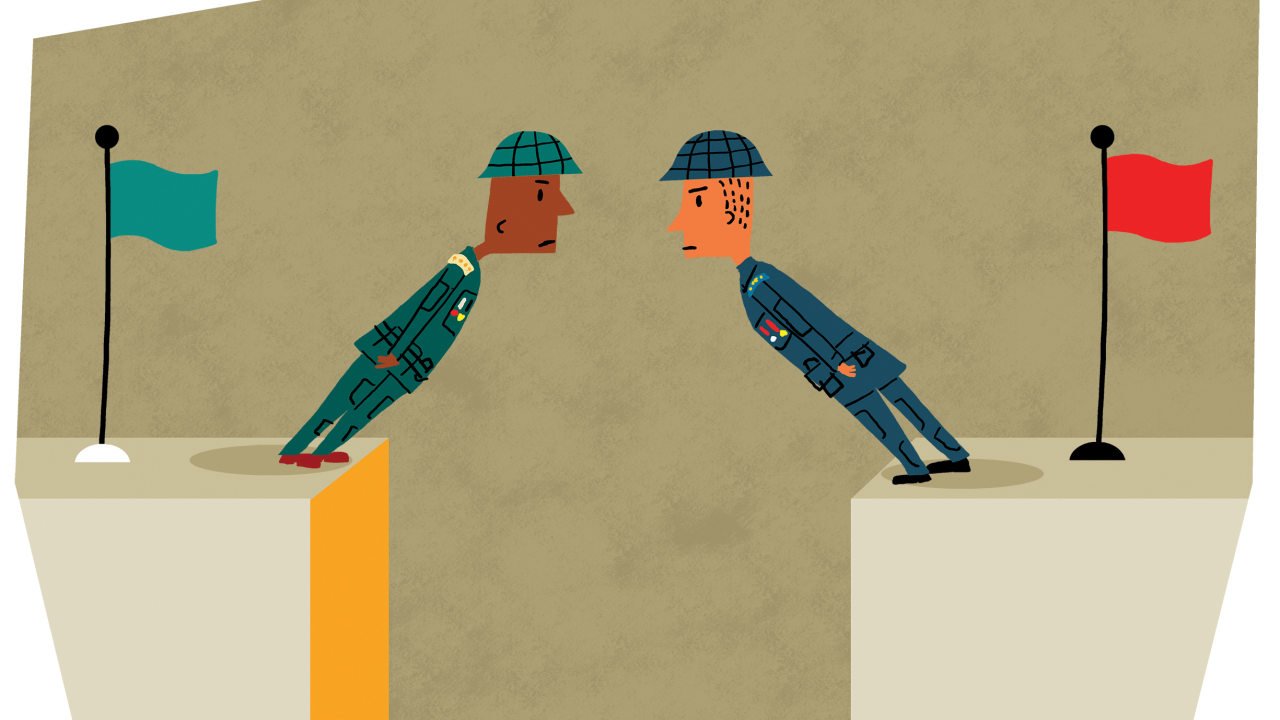
Brinksmanship refers to a strategy in international relations where actors push situations to the edge of conflict, often involving high-stakes threats or military posturing, to coerce concessions or deter opponents without necessarily intending full-scale war. This tactic gained prominence during the Cold War, exemplified by nuclear standoffs. In the context of the Far East (commonly referring to East Asia), ongoing brinksmanship in 2026 primarily revolves around escalating tensions involving China, the United States, Taiwan, North Korea, and regional allies like South Korea and Japan. Key flashpoints include China’s intensified military drills and airspace incursions around Taiwan, U.S. strategic shifts to prioritize deterring China while urging South Korea to handle North Korean threats independently, and North Korea’s advancing nuclear capabilities amid closer ties with China and Russia. These dynamics create a volatile environment, with risks of spillover effects, such as a Korean Peninsula crisis influencing the Taiwan Strait or vice versa.
Core Tenets of Realism
Realism views the international system as anarchic, meaning no central authority exists to enforce rules or provide security. States are the primary actors, acting rationally to maximize their power and ensure survival in a self-help environment. Key drivers include national interest defined in terms of power, security dilemmas (where one state’s defensive measures provoke insecurity in others), balance-of-power dynamics, deterrence strategies, and alliances formed to counter threats. Brinkmanship—pushing crises to the brink of conflict to coerce concessions or signal resolve—fits as a rational tool in this framework, allowing states to test opponents’ commitment without necessarily triggering full war.
Application to Far East Brinksmanship
Current dynamics reflect classic realist logic: intense power competition in an anarchic region, where states prioritize relative gains, deterrence, and balancing against perceived existential threats.
China’s repeated large-scale military exercises encircling Taiwan—such as the “Justice Mission 2025” drills from December 29-30, 2025, involving blockade simulations, naval maneuvers, rocket launches, and patrols pushing close to Taiwan’s outer islands like Matsu and Wuqiu—serve as coercive signaling. These actions demonstrate capability for rapid control, deter “separatist” moves, and warn against external intervention, while avoiding immediate invasion. This exemplifies realist compellence and deterrence: pushing boundaries to test resolve in a high-stakes environment.
The U.S. response, as outlined in the 2026 National Defense Strategy (released January 23, 2026), prioritizes homeland defense first, followed by deterring China in the Indo-Pacific through “denial defense” along the First Island Chain. It urges South Korea to take primary responsibility for conventional deterrence against North Korea, with only “critical but limited” U.S. support. This shift reallocates resources to counter a rising power’s regional dominance, particularly in potential Taiwan contingencies, embodying defensive realism: adapting to power imbalances and encouraging allies to bear more burdens to maintain overall balance.
North Korea’s nuclear posture—Kim Jong Un’s January 2026 statements announcing that the upcoming Workers’ Party congress will unveil “next-stage plans for further bolstering up the country’s nuclear war deterrent,” following missile tests framed as responses to geopolitical crises—illustrates self-help under anarchy. Pyongyang leverages asymmetric nuclear capabilities to deter regime change, extract concessions, and balance against superior U.S. and allied forces, especially amid closer ties with Russia and China.
Interconnected flashpoints amplify realist security dilemmas: China’s maritime coercion in the Yellow Sea pressures South Korea, narrowing the strategic distance between the Korean Peninsula and Taiwan Strait. A Korean crisis could spill over, with Beijing potentially exploiting U.S. distraction to intensify Taiwan pressure, or vice versa. Alliances (U.S.-South Korea-Japan vs. emerging China-Russia-North Korea alignments) mirror balance-of-power politics, where states counter threats through coalitions and military posturing.
These behaviors stem from material power imbalances, survival imperatives, and zero-sum perceptions—core realist hallmarks. States act as rational egoists in anarchy, using brinkmanship to manage risks while pursuing security and influence.
In 2026, amid escalating tensions and multipolar dynamics, realism remains highly relevant and influential—often described as resurgent or enduring—but not unchallenged or universally dominant.
In the Far East today, realism’s explanatory power shines precisely because the region exhibits classic realist conditions—anarchy, power transitions, security dilemmas—reinforcing why the paradigm endures, even if it has not held unbroken dominance throughout IR’s history.
Note: AI Help was taken to write this article
About the Author