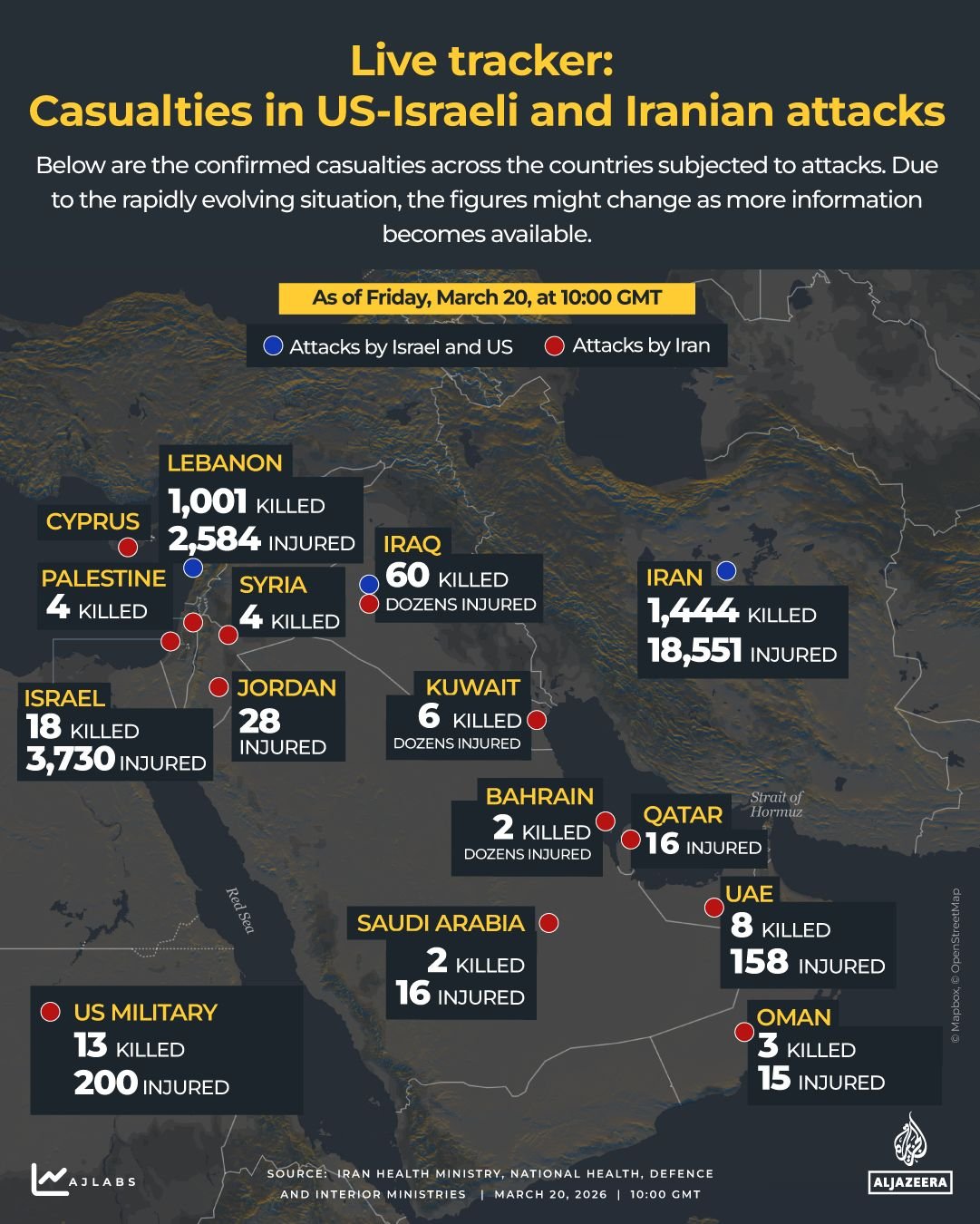
On February 28, 2026, the United States and Israel launched a massive, coordinated military campaign against the Islamic Republic of Iran, permanently altering the geopolitical landscape of the Middle East [1, 2]. What began with devastating airstrikes—including the assassination of Iran’s Supreme Leader, Ayatollah Ali Khamenei—has rapidly evolved into an open-ended, regional war [1, 3]. Three weeks into the conflict, the war has laid bare shifting strategic objectives, caused severe disruptions to global energy markets, and exposed deep fractures in international diplomacy and the global non-proliferation regime [1, 4, 5].
**Diverging Endgames: The “Venezuela Model” vs. “Mowing the Grass”**
While the United States and Israel initially coordinated their military targets closely, deep strategic fissures have emerged between U.S. President Donald Trump and Israeli Prime Minister Benjamin Netanyahu [3, 6]. The core of their disagreement lies in the ultimate endgame for the Iranian regime [6].
President Trump appears determined to implement the “Venezuela Model” in Iran [6, 7]. Mirroring his 2026 intervention against Nicolás Maduro, Trump’s strategy involves decapitating the uppermost echelon of leadership while leaving the broader state apparatus intact [7, 8]. By attempting to elevate pragmatic insiders or moderates, the Trump administration hopes to negotiate favorable terms, particularly regarding Iran’s massive petroleum reserves [7, 8]. However, this strategy hit an immediate roadblock when Iran’s Assembly of Experts selected Khamenei’s hardline son, Mojtaba Khamenei, to succeed him as Supreme Leader, a move Trump found unacceptable [9, 10].
Conversely, Netanyahu favors a “mowing the grass” strategy [6, 11]. This approach seeks the maximum degradation of Iranian military and civilian infrastructure to ensure the country remains fragmented and perpetually weak [11, 12]. Israel has struck ballistic missile launchers, air defense systems, and civilian infrastructure, including a desalination plant and an elementary school [11-13]. This divergence has caused friction over target selection; for instance, while Trump initially sought to spare critical oil facilities to prevent price spikes, the U.S. later authorized Israeli strikes on the massive South Pars natural gas field, demonstrating the volatile and shifting nature of the coalition’s military objectives [14, 15].
**The Collapse of Non-Proliferation and International Law**
The war has dealt a catastrophic blow to the 1968 Treaty on the Non-Proliferation of Nuclear Weapons (NPT) [16]. U.S. and Israeli forces executed strikes on three major Iranian nuclear facilities at Fordow, Isfahan, and Natanz without a clear legal framework [17]. European officials and international law experts have warned that these strikes constitute an act of aggression against a non-nuclear weapon state, drawing dark parallels to the 2003 U.S. invasion of Iraq [16, 18, 19].
The immediate consequence of these attacks has been the loss of international oversight [20]. In response to the bombardment, the Iranian parliament passed a bill to suspend all cooperation with the International Atomic Energy Agency (IAEA) [20]. Iran broke IAEA seals and relocated containers of enriched uranium, meaning the location of the country’s fissile material is currently unknown to the international community [20]. Experts warn that by cornering a battered but surviving “rump state,” the U.S. and Israel may have inadvertently accelerated Iran’s timeline and motivation to develop a nuclear deterrent [21-24].
**Global Shockwaves and Geopolitical Realignments**
The conflict has forced nations worldwide to navigate a treacherous diplomatic minefield [25]. Surprisingly, Iran’s closest allies—Russia and China—have not rushed to its defense [26]. Russia, bogged down in its ongoing war of attrition in Ukraine, lacks the bandwidth to project power in the Middle East and has offered Tehran little more than verbal sympathy and limited intelligence support [25, 27-29]. China, meanwhile, is prioritizing its economic stability and broader Gulf relations; Beijing has no intention of risking a direct conflict with the U.S. or jeopardizing its lucrative energy ties with Saudi Arabia over Tehran’s survival [30-32]. In fact, China’s trade turnover with the United Arab Emirates is nearly ten times its trade volume with Iran [33]. Even if the Iranian regime were to fall, any successor state would inevitably have to deal with China, which maintains a monopoly on high-tech goods and remains the primary buyer of Iranian oil [32]. Thus, Beijing has calculated that waiting out the storm is far more advantageous than intervening [32].
In Europe, the reaction has been characterized by division and apprehension [34]. The European Union is caught between a desire to defend the rules-based international order and the need to maintain transatlantic cohesion with Washington [35]. However, some allies have taken a defiant stand [36]. Spain flatly refused a U.S. request to use jointly operated military bases at Rota and Morón for operations against Iran [36]. In a swift retaliation, President Trump announced that the United States would sever all trade with Spain [37]. Conversely, nations like Argentina, which suffered devastating Hezbollah-linked terrorist attacks in the 1990s, have strongly praised the U.S.-Israeli campaign [38, 39].
**The Economic Battlefield: Choking the Gulf**
Recognizing its disadvantage in a conventional military confrontation, Iran has aggressively expanded the war into the economic domain [40, 41]. Tehran’s primary leverage point is the Strait of Hormuz, a 21-mile-wide choke point through which 20% of the world’s oil and natural gas flows [5]. Following the outbreak of war, shipping traffic through the strait plummeted by 70%, with Iran actively targeting commercial vessels and declaring ships belonging to the U.S. and its allies as “legitimate targets” [5, 42].
The immediate result was a violent spike in global energy prices, with Brent crude surging 13% and natural gas prices jumping 50% [43, 44]. However, analysts point out that the global economy entered this crisis with relatively high reserves [45]. The true vulnerability lies not with Western importers, but with Middle Eastern energy exporters [46, 47]. Oil-producing nations like Saudi Arabia, Iraq, and Kuwait rely heavily on the Strait of Hormuz [48]. If the blockade continues and local storage facilities reach maximum capacity, these nations will be forced to completely halt oil production within days [48, 49]. Qatar has already declared *force majeure* on its liquefied natural gas exports after its facilities were attacked [43, 50]. Consequently, the most intense pressure to end the conflict may ultimately come from America’s own Gulf allies, who face devastating, long-term infrastructural and revenue losses if their pipelines and storage networks collapse [36, 37].
**The Collapse of the “Axis of Resistance”**
The war has also exposed the fragility of Iran’s famed “Axis of Resistance” [51]. Instead of acting as a strategic game-changer, Iran’s regional proxies have proven largely ineffective at halting the U.S.-Israeli onslaught [51]. Hamas remains exhausted from years of war in Gaza, and Houthi forces in Yemen are too geographically distant to offer more than supplementary pressure [51].
The most dramatic proxy fallout has occurred in Lebanon [52]. After Hezbollah launched a meager volley of rockets at northern Israel, Israel responded with overwhelming force, displacing hundreds of thousands of Lebanese Shiites [53, 54]. Recognizing Hezbollah’s unprecedented weakness, the Lebanese government—supported by frustrated segments of the Shiite community—took the historic step of outlawing Hezbollah’s military activities and arresting its members [55, 56]. Geographically isolated and politically encircled, Hezbollah is facing a monumental defeat that could reshape the balance of power in the Levant [56-58].
**Conclusion**
The 2026 U.S.-Israeli war against Iran represents a massive gamble that has pushed the Middle East into uncharted territory [1]. While the military superiority of Washington and Jerusalem has successfully degraded Iran’s conventional capabilities and eliminated its top leadership, the lack of a coherent endgame threatens to plunge the region into a protracted quagmire [59-61]. Furthermore, the conflict is serving as an early test of Trump’s 2026 National Defense Strategy, which originally aimed to deprioritize foreign entanglements in favor of homeland defense and hemispheric dominance [62, 63]. If the administration becomes bogged down in nation-building or fighting a protracted insurgency in Iran, it risks the exact type of entanglement Trump has publicly disdained [64]. As global oil markets teeter on the edge of a historic supply crisis, international law fractures, and regional proxies collapse, the ultimate victor of this conflict remains dangerously uncertain [4, 5, 43]. Whether Iran emerges as a radicalized, nuclear-armed “rump state” seeking vengeance, or collapses under the weight of foreign bombardment and domestic unrest, the consequences of this war will reverberate for generations [21-23].
Featured Picture Source: Al-Jazeera
——–
Bibliography
* **Atlantic Council Experts** (2026, March 3). *Experts react: How the world is responding to the US-Israeli war with Iran*. Atlantic Council [1].
* **Fadlon, Tomer, & Klor, Esteban F.** (2026, March 11). *The Hourglass of the Energy Market: Why Might Economic Pressure Come Precisely From the Gulf States?* (No. 1029). Institute for National Security Studies (INSS) [2].
* **Ferragamo, Mariel** (2026, March 12). *The Strait of Hormuz: A U.S.-Iran Maritime Flash Point*. Council on Foreign Relations [3, 4].
* **Froman, Michael** (2026, January 30). *Iran Is a Test of Trump’s National Defense Strategy*. Council on Foreign Relations [5, 6].
* **Gabuev, Alexander, & Umarov, Temur** (2026, March 10). *Why Are China and Russia Not Rushing to Help Iran?* Carnegie Endowment for International Peace [7, 8].
* **Lob, Eric** (2026, March 20). *The Diverging U.S. and Israeli Goals in Iran Are Making the Endgame Even Murkier*. Carnegie Endowment for International Peace [9-11].
* **Maloney, Suzanne, Karlin, Mara, & Aydıntaşbaş, Aslı** (2026, March 11). *Can Iran’s regime survive the war?* (The Current Podcast). Brookings Institution [12, 13].
* **Wan, Wilfred, Chernavskikh, Vladislav, Erästö, Tytti, Fedchenko, Vitaly, & Raju, Nivedita** (2025, June 30). *Europe should help repair the damage to non-proliferation and international law from the attacks on Iran*. Stockholm International Peace Research Institute (SIPRI) [14, 15].
* **Wikipedia Contributors** (n.d.). *Foreign policy of the second Trump administration*. Wikipedia, The Free Encyclopedia [16].
* **Young, Michael** (2026, March 2). *Axis of Resistance or Suicide?* Carnegie Endowment for International Peace [17, 18].
About the Author