Rawalpindi, April 8, 2026: Pakistan has achieved an extraordinary diplomatic success that has effectively pulled the world out of a catastrophic global energy crisis. Operating as the indispensable mediator between fiercely hostile nations, Pakistan successfully pushed the United States, Israel, and Iran to agree to a two-week, “double-sided ceasefire”. This monumental breakthrough was driven by the relentless “frantic diplomacy” of Pakistani officials, who navigated deep-seated distrust to forge a pathway to peace. Pakistani Prime Minister Shehbaz Sharif proactively urged both US President Donald Trump and the Iranian leadership to implement the pause in hostilities, passionately arguing that it was necessary “to allow diplomacy to achieve conclusive termination of war”. Simultaneously, Pakistan’s army chief, Field Marshal Asim Munir, engaged in marathon, “all night long” negotiations with US administration, and Iranian Foreign Minister Abbas Araghchi. Serving as the sole communication channel between Washington and Tehran, Pakistan structured an electronic memorandum of understanding to successfully halt the fighting, says media reports.
The immediate dividend of Pakistan’s high-stakes mediation is a massive respite for the global energy market, which had been spiraling toward an unprecedented shock. The conflict had effectively closed the Strait of Hormuz—a vital maritime chokepoint responsible for the transit of over 20% of the world’s daily oil and gas supply. Global markets were in a state of panic, with US crude oil surging to a dangerous $117 per barrel. However, the moment the Pakistani-proposed ceasefire was confirmed, which included an agreement for safe passage through the strait coordinated by Iran’s armed forces, the markets experienced immediate and dramatic relief. US crude oil prices plummeted by more than 16%, dropping below $94 to $95 per barrel. This sudden stabilization rippled rapidly across the global economy, averting consumer price shocks by sending the prices of wholesale gasoline, heating oil, and natural gas sharply lower.
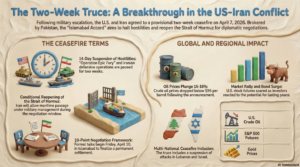
Beyond averting an immediate energy disaster, Pakistan’s intervention sparked a massive rally across global financial markets. Anticipating a stabilization of the global supply chain, S&P 500 futures surged by over 2.5%, Nasdaq 100 futures jumped nearly 3%, and the Dow Jones spiked by a massive 1,000 points. Futures tracking the Russell 2000 index also rose 2.8%, and international markets in Asia and Europe were set to open sharply higher on the news.
The success of this two-phased truce, tentatively dubbed the “Islamabad Accord,” has laid a concrete foundation for a broader peace. Under Pakistan’s proposed framework, the initial 15-to-20-day ceasefire window will be utilized to hold in-person negotiations to settle all disputes. These critical talks are scheduled to begin on Friday, April 10, hosted in Pakistan’s capital, Islamabad. As an analyst observing the geopolitical landscape, it is clear that by successfully managing the complex egos and volatile dynamics of this conflict, Pakistan has secured a massive diplomatic victory. Through its swift and decisive actions, Islamabad has stopped the immediate bloodshed, reopened critical trade routes, and provided a crucial lifeline to a global economy that was teetering on the brink of disaster.
About the Author