A Research Based Analysis
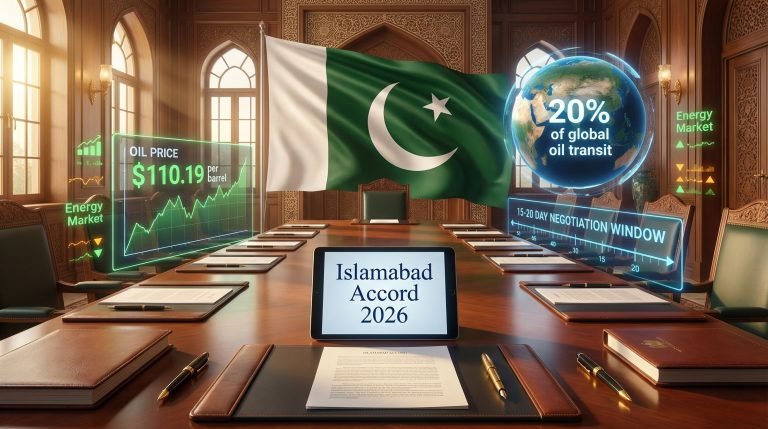
The Islamabad Accord 2026 represents a new model of 21st-century conflict management—one where wars are not ended through decisive victory, but paused through negotiated ambiguity.Pakistan’s emergence as a diplomatic pivot, reinforced by China’s strategic backing, signals a shift toward multi-polar mediation frameworks. Yet, the peace remains inherently fragile, vulnerable to narrative breakdowns, sequencing disputes, and regional spoilers.Ultimately, the success of this process will depend not on eliminating conflict, but on managing it within tolerable limits—transforming a volatile confrontation into a controlled, if uneasy, equilibrium.
The April 2026 ceasefire marks a critical transition from full-spectrum conflict—triggered by “Operation Epic Fury”—to a fragile diplomatic pause mediated by Pakistan and China. This article examines the competing American (15-point) and Iranian (10-point) frameworks, Pakistan’s emergence as a “Global Pivot” in crisis diplomacy, and the structural risks posed by regional spoilers. It argues that the ceasefire is not a resolution but a carefully engineered informational and strategic compromise, sustained through ambiguity, sequencing, and controlled narratives.
1. From Shock and Awe to Strategic Pause
The conflict escalated rapidly following the February 28 “Decapitation Strike,” which eliminated key Iranian leadership and triggered a multi-front regional response. By early April, both sides reached a point of mutual exhaustion:
The United States achieved tactical military superiority but faced severe economic backlash due to the closure of the Strait of Hormuz and surging global oil prices.
Iran, though strategically weakened, leveraged its geographic control over the Strait as a chokepoint weapon, forcing a diplomatic opening.
The April 8 ceasefire thus emerged not from trust, but from coercive interdependence—each side retaining the ability to inflict unacceptable costs on the other.
2. The War of Narratives: Constructing “Victory”
Even before negotiations began, the ceasefire was framed through competing narratives:
U.S. Position (“Victory through Strength”): A temporary 14-day pause to enforce compliance on nuclear and maritime demands.
Iranian Position (“Resistance Prevails”): A strategic win forcing U.S. retreat and recognition of Iran’s regional role.
Pakistani Position (“Regional Stabilizer”): A comprehensive ceasefire across all fronts, showcasing diplomatic leadership.
This divergence reflects a deeper phenomenon: the architecture of perception. Each actor must maintain domestic legitimacy by claiming victory, producing what can be termed “digital malnutrition”—an information environment saturated with selective truths and strategic exaggerations.
3. The Islamabad Framework: 10 vs. 15 Points
At the heart of the Islamabad talks lies a zero-sum negotiation structure:
The U.S. “Clean Slate” Framework (15 Points)
Removal of enriched uranium (“nuclear dust”)
Conditional sanctions relief
Immediate and unconditional reopening of the Strait of Hormuz
Preference for international oversight of maritime routes
The Iranian “Sovereignty” Framework (10 Points)
Recognition of the “right to enrich”
Immediate sanctions relief and asset unfreezing
Strait reopening under a security protocol (potential tolls/monitoring)
Expansion of ceasefire to all fronts, including Lebanon
👉 Core Tension:
The U.S. demands disarmament first, while Iran demands recognition and relief first.
This sequencing conflict is the central obstacle to durable peace.
4. Pakistan as a “Global Pivot”: The Security–Diplomacy Nexus
Pakistan’s mediation success is rooted in its unique ability to bridge military credibility and diplomatic access:
Military Channel: Direct engagement between Field Marshal Asim Munir, U.S. CENTCOM, and Iranian military leadership ensured trust in security guarantees.
Diplomatic Channel: Hosting high-level delegations, including Vice President JD Vance and Speaker Mohammad Bagher Qalibaf.
Sino-Pakistani Axis: China provided the economic “backstop” and strategic pressure on Iran, while Pakistan offered neutral ground and logistical coordination.
This dual structure—Chinese financial leverage + Pakistani diplomatic infrastructure—forms the backbone of the Islamabad Accord.
5. The Lebanon Tripwire: Fragility at the Periphery
The most immediate threat to the ceasefire lies in Lebanon:
Pakistan asserts the ceasefire includes all fronts.
Israel rejects this interpretation and continues military operations.
This creates a dangerous ambiguity:
For Iran, Israeli strikes constitute a violation.
For the U.S., they are treated as a loophole outside the agreement’s scope.
👉 Implication:
The ceasefire’s survival depends on whether actors treat such incidents as exceptions or triggers for escalation.
6. The Northern Front: Afghanistan as a Spoiler Domain
Beyond state actors, the conflict is vulnerable to non-state spoilers, particularly:
TTP (Tehrik-i-Taliban Pakistan)
IS-K (Islamic State Khorasan Province)
Operating from Afghan territory, these groups benefit from prolonged instability.
Strategic Logic of Spoilers
Peace reduces their relevance and recruitment potential.
Escalation restores chaos, visibility, and funding streams.
Policy Implication
Afghanistan must remain excluded from the Islamabad process to:
Prevent legitimization of spoilers
Maintain focus on primary state actors
Avoid dilution of negotiation objectives
7. The Strait of Hormuz
The Strait remains the central bargaining chip:
Iran views it as a sovereign-controlled chokepoint with potential economic returns (tolls/protocols).
The U.S. views it as a global commons requiring unrestricted access.
Global oil prices serve as a real-time indicator of trust:
High prices → market skepticism
Stabilization → perceived credibility of the ceasefire
8. The 14-Day Horizon: A Suspended War
The current ceasefire is best understood not as peace, but as a “suspended war”—a temporary pause sustained by:
Strategic ambiguity
Narrative flexibility
Controlled escalation thresholds
Its success depends on creating “semantic escape hatches”:
Allowing the U.S. to claim a victory of strength
Allowing Iran to preserve a resistance narrative
Without these symbolic concessions, domestic pressures may collapse the negotiation process.
9. Consideration/Conclusion
To transition from fragility to stability, the following measures are critical:
1. Extend the Timeline
Expand the 14-day ceasefire into a 45-day stabilization window
Provides space for phased implementation and trust-building
2. Tripartite Maritime Monitoring
Establish a joint U.S.–Iran–Pakistan monitoring cell in Gwadar
Ensure transparency and shared control over Strait operations
3. Lebanon Deconfliction Mechanism
Create a parallel channel to manage Israel-related escalations
Prevent peripheral conflicts from collapsing core negotiations
About the Author