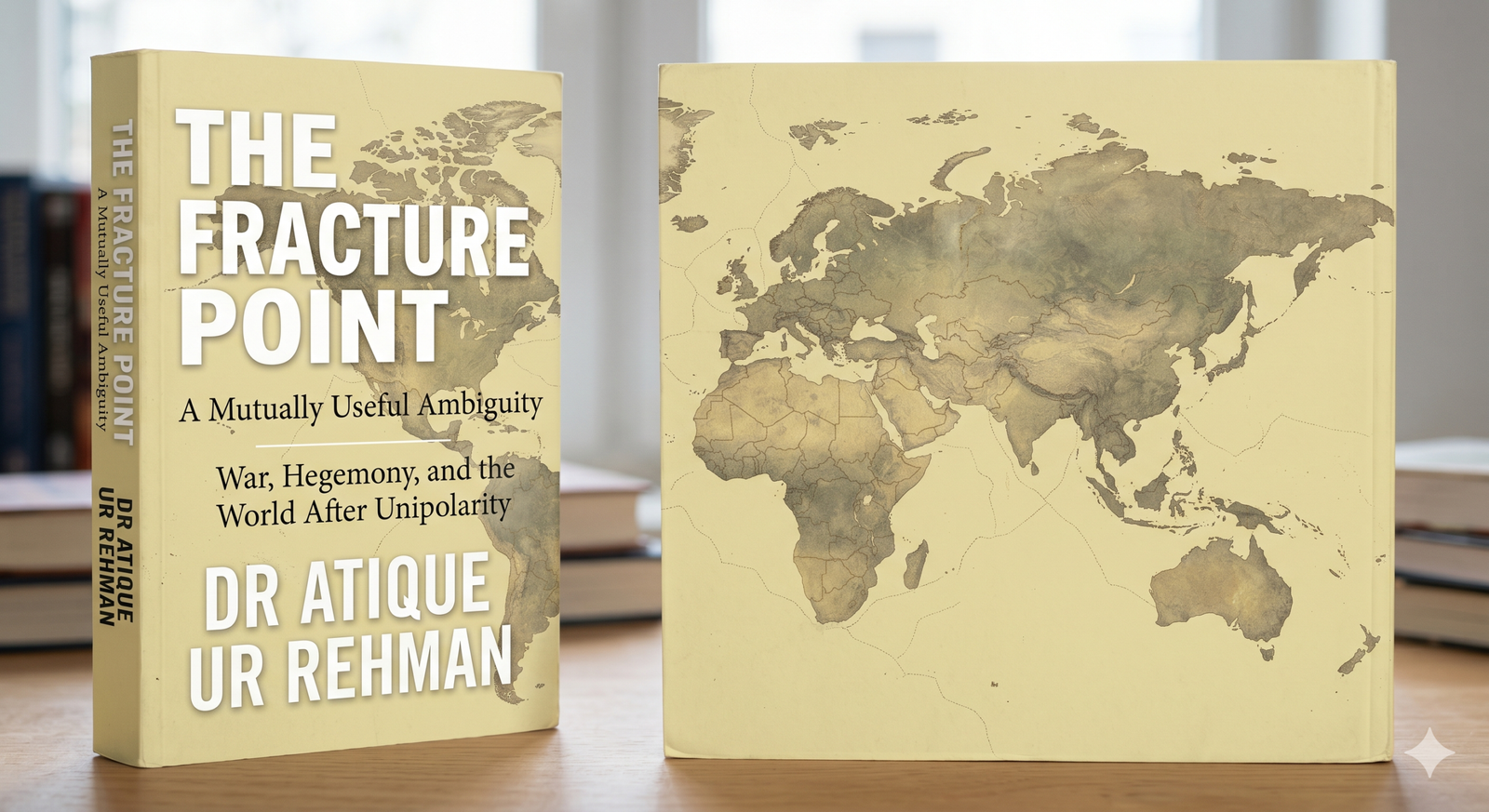
The Fracture Point: A Mutually Useful Ambiguity is the definitive strategic analysis of the most consequential geopolitical crisis of the 21st century — the 2026 Iran war, the closure of the Strait of Hormuz, and the bilateral US-China summit that declared global stability while the world’s most critical waterway remained shut.
Drawing on Mearsheimer and Rosato’s foundational argument that states are rational actors in a structurally irrational system, Barry Buzan’s 2011 prediction of decentred globalism, and Sohail Inayatullah’s Causal Layered Analysis, Dr. Atique Ur Rehman constructs a unified argument across twenty chapters: the 2026 crisis was not an aberration produced by reckless leaders or irrational adversaries. It was the rational outcome of rational actors — states, non-state entities, multinational corporations, and artificial intelligence systems — pursuing rational interests within a structural environment that makes conflict, closure, and fragmentation the most logical choices available to them.
The book moves across five analytical movements. Part One traces the fifteen-year demolition of the post-1945 order — from the Syria veto that destroyed UN legitimacy, through Crimea, the JCPOA withdrawal, COVID’s supply chain revelation, and the expiration of New START — and maps the four accelerants that compounded state-level stress into civilizational complexity: the parallel state system of non-state actors, the hollow architecture of international institutions, the technopolar sovereignty of Big Tech corporations, and generative AI’s dissolution of the shared informational reality on which all governance depends.
Part Two delivers the crisis in full operational detail — the Indian Ocean’s strategic geography, the game-theoretic logic of the US-Iran confrontation modelled across three levels, the weaponization of global supply chains through the energy war, the vulnerability of submarine cable infrastructure, and the unified doctrine of synthetic attrition that merged drone saturation with AI-generated information warfare into a single operational framework.
Part Three turns to Pakistan’s extraordinary emergence as the architect of the Islamabad Process — the first direct US-Iran talks since the Islamic Revolution — analyzed with unflinching precision: what was genuinely achieved, what structural limits constrained it, and what the distinction between functional and structural mediation means for Pakistan’s strategic future.
Part Four deconstructs the Beijing summit’s “mutually useful ambiguity” — demonstrating that Washington left advertising deals while Beijing left advertising a doctrine, that neither party conceded a single strategic objective, and that the bilateral stability framework declared in the Great Hall of the People is structurally incapable of governing the Strait it claims to have stabilized, the de-dollarization it cannot acknowledge, or the five actors — Iran, Russia, India, the Gulf, and Europe — whose independent agency the bilateral frame cannot contain.
Part Five applies Causal Layered Analysis across four levels — Litany, Systemic, Worldview, and Myth — to generate five structurally distinct future trajectories, from the Concert of Necessity to the Cascading Fragmentation of a Middle East nuclear cascade, identifying the precise level of intervention each trajectory requires and the window within which that intervention remains possible.
The Fracture Point is the book that names what the Beijing summit could not: that the world’s most powerful states have constructed a shared surface of stability beneath which the compound fracture deepens, and that the question the Strait of Hormuz has forced civilization to confront is as old as Thucydides — and as urgent as tomorrow morning. Book Coming Soon
About the Author