
Insights from 2023 Data.
A fascinating analysis of global education trends reveals a compelling correlation between a nation’s economic prosperity and its investment in engineering education. A recent diagram titled “Building brains,” based on data from 2023 or the latest available figures, highlights this relationship across 96 countries with available data, drawing from sources such as China’s Ministry of Education, UNESCO, and the World Bank.
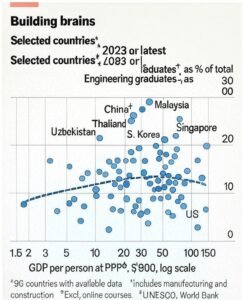
The diagram plots GDP per person at purchasing-power parity (PPP) in thousands of dollars on a log scale, ranging from 1.5 to 150, against the percentage of engineering graduates (including manufacturing and construction) out of the total graduates, spanning from 0% to 30%. This visualization offers a clear snapshot of how economic development aligns with the production of engineering talent.
Key Observations
Several countries stand out in this analysis. China and Malaysia lead the chart with the highest percentages of engineering graduates, both hovering around 25-30%. This suggests a strong emphasis on technical education, likely driven by their robust manufacturing and infrastructure sectors. Thailand, Uzbekistan, South Korea, and Singapore follow, with engineering graduate percentages ranging between 15-25%, reflecting diverse approaches to balancing technical and other fields of study.
In contrast, the United States presents a different picture, with a notably lower percentage of engineering graduates, estimated between 5-10%. This could indicate a broader diversification of educational fields or a different economic focus compared to the leading Asian nations.
The Trend Line
A dashed red trend line overlays the scatter plot, indicating a general positive correlation. As GDP per person increases, the proportion of engineering graduates tends to rise. This trend suggests that wealthier nations may prioritize or naturally develop stronger engineering education systems, possibly to sustain or advance their economic growth through innovation and infrastructure development. However, the data also shows significant variation, with some countries deviating from the trend, hinting at unique national policies or cultural factors influencing educational choices.
Implications and Context
This correlation raises interesting questions about the role of engineering education in driving economic success and vice versa. Countries with higher GDP per person might have the resources to invest in technical training, while a strong engineering workforce could, in turn, fuel economic growth through technological advancements and industrial output. The inclusion of online courses and Excel-based data in the analysis further underscores the modern, adaptable nature of engineering education globally.
As of 08:56 AM PKT on October 5, 2025, this data provides a valuable benchmark for policymakers and educators. It highlights the need for tailored strategies—whether increasing engineering enrollments in wealthier nations like the US or leveraging technical education as a growth engine in developing economies like Uzbekistan. The “Building brains” diagram serves as a powerful tool for understanding how education and economics intertwine, shaping the global landscape of innovation and development.
About the Author