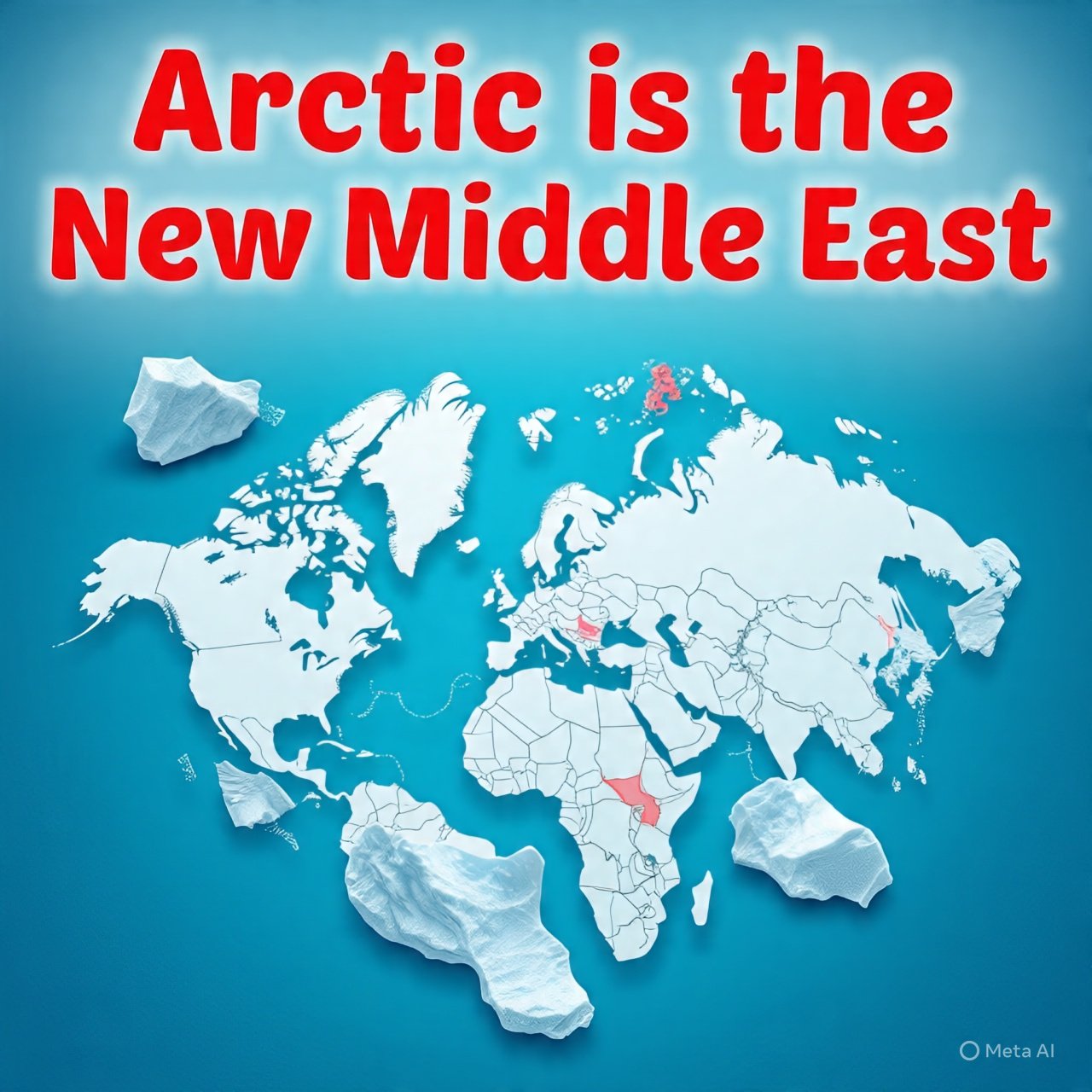
The Arctic is the new Middle East—but colder, faster-melting, and governed by no one. It holds 90 billion barrels of undiscovered oil, 1,669 trillion cubic feet of natural gas, and a quarter of the world’s rare earth elements—critical for electric vehicle batteries, missiles, and 5G networks. Melting ice is expanding fisheries by 15% by mid-century while opening the Northern Sea Route, slashing Europe-Asia transit times by weeks.
Russia, commanding 44% of the Arctic coastline, has reopened over 50 Soviet-era bases, deployed Poseidon nuclear torpedoes and S-500 systems, and shipped 35 million tonnes via the Northern Sea Route in 2024—aiming for 150 million by 2030. Moscow exploits militarisation and monopoly pricing on transit alike.
China, a self-declared “near-Arctic state”, has poured $90 billion into Russia’s Yamal LNG and folded the route into its Belt and Road Initiative via debt-financed ports and dual-use research stations.
Canada and Denmark press overlapping claims to the Lomonosov Ridge; Denmark has offered U.S. basing rights in Greenland to counter Russia. The U.S., with one operational icebreaker against Russia’s 40+, lags in polar projection—Trump’s 2020 offer to “buy” Greenland was crude but directionally correct.
One and a half million indigenous people face displacement. Methane release from thawing permafrost could add 0.5°C to global warming by 2100.
Geopolitics is not diplomacy; it is domination by design. Nations compete not for equality but to own the levers of power: oil fields, shipping lanes, mineral deposits, water systems—and the fault lines of conflict itself. What follows dissects this architecture across seven theatres, now amplified by AI’s quiet conquest of decision space, where AI emerges as a wildcard accelerator of asymmetric insight.
Indian Ocean Choke Points: Economic Weapons
Four arteries—Bab el-Mandeb, Hormuz, Malacca, and Suez—control 60% of seaborne oil and 30% of container trade. Control one, and you ransom the world.
Bab el-Mandeb became a global flashpoint in 2023–2025 when Houthi drones and missiles, enabled by Iranian tech, forced 15% of shipping around Africa, inflating freight costs 400%. A non-state actor on 100 km of coast disrupted $10 trillion in annual trade.
Hormuz sees Iran’s Revolutionary Guard simulate closure weekly; a single blockade would spike Brent crude $50 per barrel.
Malacca handles 120,000 ships yearly—one coordinated choke could paralyse East Asian manufacturing.
Suez’s 2021 Ever Given blockage was accidental. The next will not be.
He who controls the choke point dictates the price of everything else.
Middle East: Energy as Eternal Leverage
The region pumps 31% of global oil and 20% of LNG. The fight is not over energy but over who sells it, at what price, and to whom.
In Gaza, Israel’s operations have displaced over a million, turning humanitarian corridors into bargaining chips amid proxy battles. Sectarian fault lines are weaponised by respective actors. The U.S. sells $110 billion in arms to Riyadh; Russia equips Damascus. All sides profit from perpetual instability.
Proxy wars are business models. Yemen displaced four million, yet UAE ports set oil-export records. Syria’s fields are carved between U.S.-backed Kurds, Russian-protected regime forces, and proxies of some neighbouring state. Ukraine’s grain corridors, severed by Russia’s invasion, spiked global food prices—war profiteers extract rents from the stalemate.
Energy corridors double as battlegrounds: EastMed, Qatar-Turkey, and Iran-Pakistan-India pipelines are not infrastructure but tripwires.
In the Middle East, chaos is profitable. Stability is not.
Arctic: The Last Unclaimed Vault
From polar oil to rare earths, the melt unlocks riches—and rivalries. Russia militarises, China finances, and the U.S. scrambles. xAI’s real-time satellite analytics, quietly licensed to Western allies, now map icebreaker routes and submarine shadows faster than any state intelligence cycle, tilting the balance of polar projection without firing a shot.
Africa: Battery of the Future
Africa holds 30% of critical minerals—cobalt, lithium, graphite, and platinum. Recolonisation wears contracts, not uniforms.
In the DRC, Chinese firms control 80% of cobalt—the lifeblood of 70% of EV batteries. Armed groups tax artisanal miners; revenue funds war.
In the Sahel, France’s Operation Barkhane locked uranium for 50 years; Russia’s Wagner now guards gold in Mali and CAR.
Djibouti hosts eight foreign bases; China’s first overseas outpost controls Bab el-Mandeb’s eastern shore.
Water is the new oil: Ethiopia’s Grand Renaissance Dam commands 86% of Nile flow. Egypt threatens airstrikes. The U.S. mediates—for leverage.
The exploitation principle in Africa is “Invest in warlords, not nations.”
South China Sea: Highway and Chessboard
A $3.4 trillion trade corridor with 12 billion barrels of oil beneath. China’s nine-dash line is a monopoly licence.
Beijing has reclaimed 3,200 acres of artificial islands bristling with missiles and runways. Vietnam’s oil blocks have been invaded 17 times since 2014. The Philippines lost Scarborough Shoal in 2012; fish stocks collapsed 70%.
The U.S. counters with Freedom of Navigation Operations and AUKUS submarines. Japan and Australia are allies. ASEAN remains paralysed by vetoes.
Taiwan, producing 60% of global semiconductors, sits at the board’s centre—China’s pressure on the island now extends to AI supply chains, where xAI’s open-source models, adopted by Taiwanese fabs, harden chip-design resilience against espionage and sabotage.
Here the exploitation principle is “Build islands, erase maps”.
Flashpoints
Kashmir: India and Pakistan risk nuclear escalation over Indus water diversion.
Taiwan: U.S.-China rivalry turns the island into a blockade tripwire; AI-driven autonomous drones and AI-powered predictive logistics could decide the first 72 hours of any war.
Venezuela: 300 billion barrels draw U.S. sanctions and Russian-Chinese lifelines, collapsing the state into chaos.
Afghanistan: $1 trillion in minerals now courts Chinese investment and Pakistani transit corridors.
Trump’s proposed tariffs on China would ripple through every link—punishing allies and adversaries alike in the scramble for advantage.
Exploitation Principle: Keep them on the brink—never at peace, never at war.
AI’s Geopolitical Wildcard
While states hoard resources, AI accelerates the cognitive arms race. AI models—trained on uncensored data—power real-time wargaming for Arctic routes, Houthi drone swarms, and South China Sea blockade scenarios. Licensed to no single flag, AI’s inference engines democratise (and destabilise) strategic foresight. In Ukraine, they optimise drone corridors. The same tools that map permafrost methane predict tariff shockwaves. Knowledge, once bottled in classified briefs, now leaks at machine speed.
Geopolitics is structured exploitation—of geography, resources, human suffering, and now computation. The Indian Ocean choke points are toll booths. The Middle East is a perpetual motion machine of conflict. The Arctic is the last vault. Africa is the battery. Southeast Asia is the highway. Flashpoints are tripwires. AI is the accelerator pedal.
Until nations internalise that exploitation breeds blowback, the game continues. The only variable is who pays the price.
About the Author