

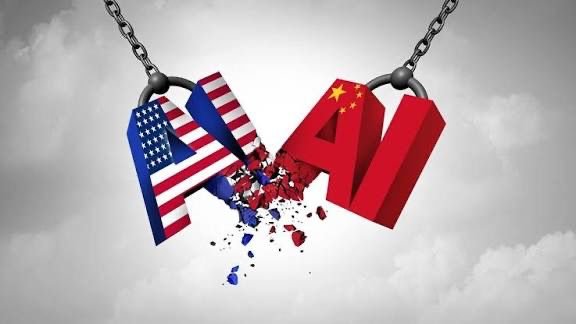
The United States and China are both leaders in the race for artificial intelligence (AI), but by 2025, their methods and results will be very different. The U.S. stays ahead mostly because of private investment, cutting-edge gear, and top-notch schools. China’s strength comes from its government policies, huge data resources, and quickly rising workforce. This study is based on the most recent reports, which show that the U.S. is still ahead in AI generally, but China is quickly catching up.
- Investment in AI • The U.S. invested $109.1 billion in AI in 2024, which is 12 times more than China’s $9.3 billion. This is estimated to reach $320 billion by 2025, mostly because of private firms. The government has put in about $11.2 billion. • China’s Position: By 2025, China’s overall investment in AI is expected to be between $84 billion and $98 billion, with the government contributing $8.2 billion. By 2030, China wants to use AI in 90% of its economy. • Conclusion: The U.S. is ahead by a large margin, thanks to strong investment from the private sector.
2. Data
China’s Strength: China has a population of 1.4 billion people and a lot of digital infrastructure, like WeChat and Alipay. This means that it creates a lot of data that AI can use to learn. In 2025, data-sharing platforms like OpenI and datasets like FlagData are speeding up the development of AI thanks to internet scraping and government databases.
* The U.S. possesses a lot of high-quality and varied data (for example, from Google and Meta), but not as much as China. Data gathering is limited by privacy laws, which are based on the GDPR.
Conclusion: China’s huge data resources provide it a big edge, making AI models like DeepSeek R1 work better.
3. Talent Pool
China’s Advantage: China has more than 100,000 AI researchers, and in 2025, it will have 47% of the world’s best AI researchers (the U.S. will have 18%). This is happening because a new generation is doing well in STEM education and PhD graduates are coming back to the U.S.
U.S. Position: The U.S. boasts more than 10,000 top-notch researchers, thanks to immigration and elite schools like Stanford. But it depends more and more on Chinese-born personnel (38% of the best AI workers are of Chinese heritage).
Conclusion: China has a big advantage that puts it in a good position to lead for a long time.
4. Automation
China’s Advantage: China’s AI-powered automation (such robotics and factory automation) is quite advanced at the industrial level. 78% of businesses will use robots by 2025, and most of them will be exporting them. The “Made in China 2025” program has added AI to farming and industry, which has boosted productivity by 15%.
U.S. Position: AI automation in the U.S. is great for the service sector (such healthcare and banking), but not as well for industry (55–78%, behind China).
Conclusion: China is well ahead, especially when it comes to big industrial uses.
5. AI Companies
U.S. Advantage: The U.S. has more than 9,500 AI companies as of 2025. This is over five times as many as China’s 2,000. This is because of new companies like Anthropic and xAI, which will create 40 new AI models in the U.S. in 2024.
China’s Position: China has more than 5,300 AI enterprises, including 302 registered generative AI services. However, it is behind the U.S.
Conclusion: The U.S. has a big edge that encourages competition and new ideas.
6. Use in military equipment
China’s Advantage: China is quickly adding AI to military uses, like drones, swarms, and surveillance (540 million AI cameras). The People’s Liberation Army (PLA) is using AI for “intelligentization” by 2025, thanks to homegrown chips like the Huawei Ascend, even though the U.S. has put sanctions in place.
U.S. Position: The U.S. uses AI in defence (for example, drone strikes and Palantir), but progress is slower because of red tape and firms not wanting to get involved (for example, Google’s initial opposition). • Conclusion: China has a big edge since their government-driven integration happens faster.
Final Thoughts Overall, the U.S. is ahead in AI research, especially when it comes to funding, the number of businesses, and the quality of models. This keeps the U.S. ahead in both technology and the economy. But China is quickly catching up, thanks to its advantages in data, skill, robotics, and military applications. By 2030, the balance may shift. This competition affects not only technology but also the way countries interact with each other. For example, U.S. restrictions like chip export controls speed up China’s domestic innovation.