

The image outlines key trends in AI agent development for 2025, categorized into five main areas: Agentic RAG, Voice Agents, CUA (Computer Using Agents), Coding Agents, and DeepResearch Agents. Each trend is supported by specific technologies and workflows.
- Agentic RAG (Retrieval-Augmented Generation):
- Focuses on AI agent workflows using real-time data retrieval and generation.
- Involves memory, planning, and tools (e.g., Google Search, Vector DB) integrated into a system prompt for output generation.
- Key players: xAI, Google, Harvey, Perplexity.
- Voice Agents:
- Intelligent agents interacting with users via natural spoken language.
- Incorporates STT (Speech-to-Text), TTS (Text-to-Speech), and telephony.
- Supports real-time data retrieval and generation.
- CUA (Computer Using Agents):
- Agents that mimic human-computer interaction, altering traditional usage patterns.
- Utilizes a desktop sandbox with data, tools, and vector DB for operation.
- Coding Agents:
- AI agents designed for coding, debugging, and building applications faster.
- Includes components like code generators, debuggers, test runners, and environments.
- Supported by third-party tools and code-specific utilities.
- DeepResearch Agents:
- Collaborative multi-agent systems for building extensively researched reports.
- Features an aggregator agent, citation agent, and sub-agents (S-Agent 1 to n) with memory and tools.
- Supports protocols like A2A (Agent-to-Agent) and MCP (Multi-Agent Communication Protocol).
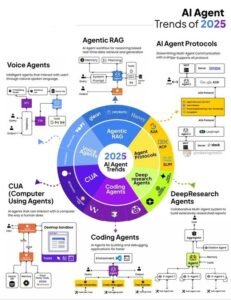
Additionally, the image highlights AI Agent Protocols (e.g., A2A, MCP, SLIM, ACP) for streamlining multi-agent communication, and tools like Google ADK, LangGraph, and Stride for implementation. The trends reflect a shift toward integrated, intelligent, and collaborative AI systems.