

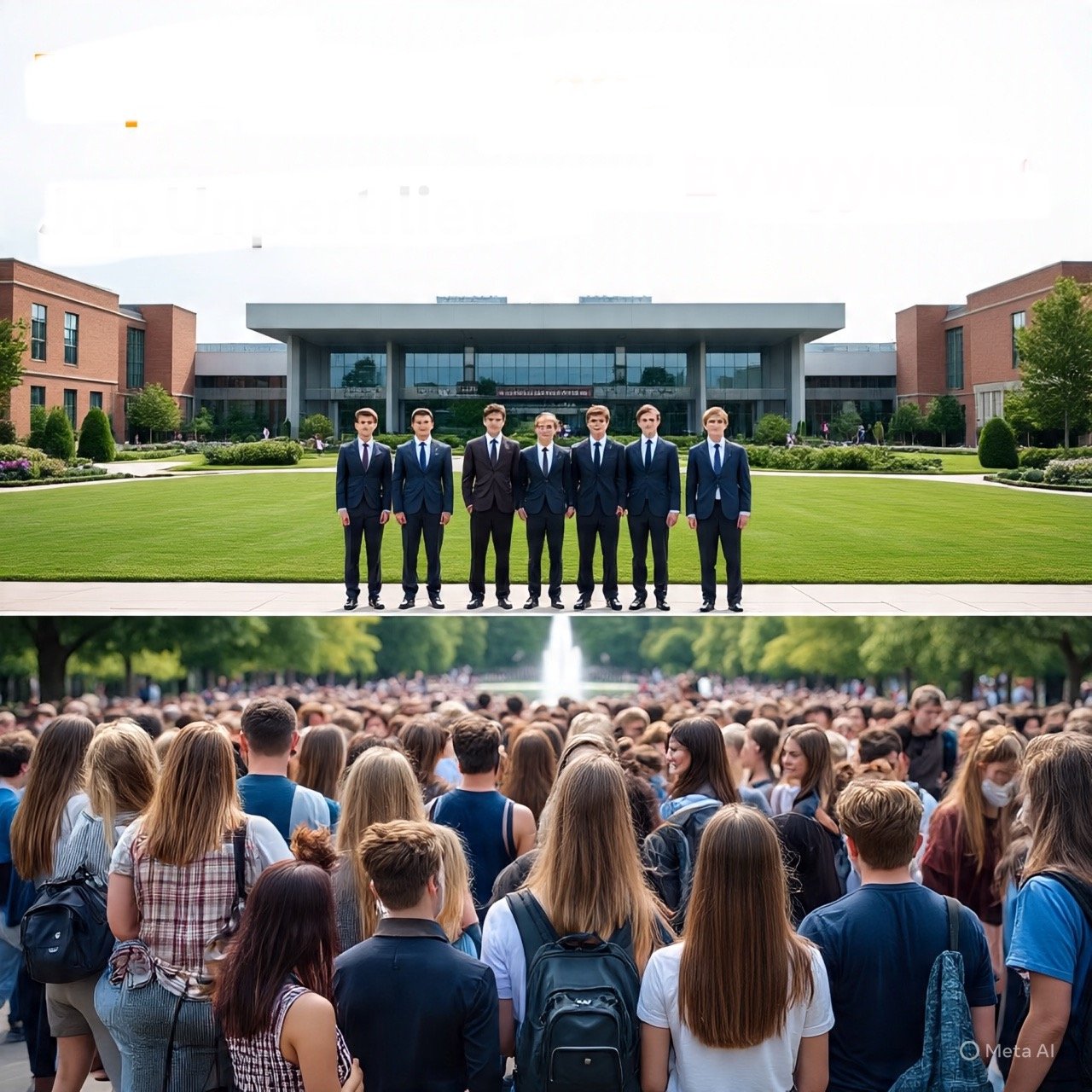
CAMBRIDGE, SINGAPORE, ANYTOWN, USA — Step into MIT’s Media Lab, where the air crackles with the hum of 3D printers and the tang of solder, or Oxford’s ancient quads, where old books and fresh ideas scent the crisp air. Now picture a lecture hall at any university in Pakistan —fluorescent lights buzzing, chalk dust settling on worn desks. The contrast is stark. Elite universities like MIT, Imperial College London, and Harvard, crowned by the 2025 QS World University Rankings, are powerhouses, churning out grads who land dream jobs, lead with vision, and knit society’s fraying fabric. Here in our universities and colleges and other non-elite schools and colleges, while vital, often lag in resources, networks, and impact. Through vivid stories and hard numbers, here’s how the world’s best outpace the rest, and where everyday colleges hold their own.
Learning That Lights a Fire vs. Teaching to the Test
At elite universities, classrooms are alive with possibility. At MIT, ranked number one globally, Aisha, a junior, hunches over a cluttered bench in the Media Lab, her fingers smudged with solder as she rigs a drone to deliver medical supplies to remote villages. The room buzzes with pizza-fuelled debates among engineers and anthropologists. “It’s not about grades,” she says, eyes bright. “It’s about building something real.” Her prototype snagged a biotech internship, part of the 90% of MIT grads employed in high-impact roles within six months, per alumni data.
Contrast that with a underfunded public university in Pakistan. There, student X, a mechanical engineering major, sits in a packed lecture hall, scribbling notes from a PowerPoint on thermodynamics. The professor, juggling 200 students, sticks to the textbook. Labs are limited—outdated equipment, long waits. Student X’s project, a basic gear system, feels like a checkbox, not a breakthrough. “I learn the material,” he shrugs, “but it’s not like I’m changing the world.”
This contrast between elite and everyday university is visibly a source of unrest even in western countries.
In USA, Only 65% of State U’s 2023 grads found jobs in their field within six months, per National Association of Colleges and Employers (NACE) data.
Stanford’s d.school is a creative crucible. Raj, a biology major, sketches vertical farms on a whiteboard, the marker’s sharp scent mixing with coffee as his team—designers and economists—tackles urban hunger. His project landed a nonprofit gig. At Regional College, a non-elite school nearby, Maria’s biology class relies on virtual labs due to budget cuts. “We simulated dissections,” she says, “but I’ve never held a scalpel.” Her skills, while solid, don’t pop for employers, with only 50% of her peers securing field-related jobs, per local surveys.
Imperial College London uses AI to tailor learning, boosting retention by 30%, per their data. Sarah, a chemistry student, taps a glowing tablet in a sunlit lab, her coursework adapting to her pace. At Community College East, budget constraints mean outdated software and overcrowded classes. Tom, a chemistry major, shares textbooks and rarely sees his overworked professor outside lectures. “I’m learning,” he says, “but it’s sink or swim.” Elite schools’ hefty endowments—Harvard’s $50 billion vs. State U’s $200 million—fuel cutting-edge facilities and personalised teaching, leaving non-elites scrambling to keep up.
Jobs: Rocket Ships vs. Slow Climbs
Elite universities are job-launching machines. The 2025 Global University Employability Ranking crowns MIT and Stanford for grads who code like wizards and pitch like pros. At Oxford, Liam, a history major, sips tea in a book-lined career office, the clink of porcelain punctuating his chat with a Goldman Sachs recruiter. His AI ethics micro-credential, earned through late-night case studies, sealed a $75,000-a-year job—a rarity for humanities grads. NACE reports 85% of 2023 bachelor’s grads from top U.S. schools like Harvard were employed or in grad school within six months; 90% for master’s holders.
At non-elite colleges, the path is rockier. At State U, Emily, a history major, visits a career fair in a draughty gym, clutching a generic resume. The booths—mostly local firms—offer retail or admin roles, not her dreamed-of museum curator gig. Only 60% of her class landed field-related jobs, per NACE. ETH Zurich’s Elena, testing solar panels in a lab scented with metal and ozone, had three job offers by graduation, joining 95% of her peers employed within three months. At Regional Tech Institute, non-elite but respected, Mark’s engineering internship was unpaid, and his job hunt stretched months, with 70% of grads employed per local data.
Alumni networks are a game-changer. Harvard’s Maria, over espresso in a bustling Cambridge café, connects with a startup founder alum, landing a fintech role. At Community College West, Sarah’s network is local—her advisor’s LinkedIn is sparse. “I’m on my own,” she says, applying to entry-level roles with 55% of her peers employed, per college stats. Elite schools’ global connections and endowments fund robust career services, while non-elites rely on stretched staff and regional ties. Yet, non-elites shine for local impact—State U’s nursing grads, trained in nearby hospitals, fill critical shortages, with 80% employed locally.
Leaders Who Heal vs. Grads Who Get By
Elite universities don’t just produce workers; they forge leaders who mend society. At Harvard’s Kennedy School, Omar, in a dimly lit seminar room thick with coffee and tension, role-plays a UN diplomat tackling climate refugees. His plan, scrawled on crumpled notes, wins real policymakers’ praise. “It felt like millions were counting on us,” he says, now shaping D.C. migration policy. Stanford’s Knight-Hennessy Scholars see Maya trudging through Silicon Valley rain, her shoes soaked as she pitches rent control to city officials. Her model’s now a city pilot.
At State U, leadership training is thinner. Jake joins a student government club, but it’s more about planning dances than policy. “I learnt teamwork,” he says, “but nothing like running a crisis sim.” Only 20% of State U grads enter public service, per alumni surveys, compared to 40% from elite schools. At Cambridge, Anika’s boots crunch on Indian village gravel, the monsoon’s earthy scent heavy as she tests water filters for 10,000 people. At Regional College, Maria’s community service is a one-off food drive, not a capstone. “It was nice,” she says, “but it didn’t change me.”
Diversity efforts highlight the gap. Penn’s Ayesha, in a sunlit hall, joins bias-training sessions, her voice mingling with raw confessions that bridge divides. She now leads corporate diversity. At Community College East, Tom’s diversity training is a single online module, underfunded and impersonal. “It felt like a checkbox,” he says. NUS’s Chen, whose parents were migrants, works in a humid Singapore lab, the clatter of tools fuelling his startup for workers’ wages. At a non-elite urban college, Lisa’s volunteer work with local immigrants is heartfelt but lacks funding for scale. Still, non-elites excel in community ties—Urban’s grads often stay local, strengthening regional cohesion.
The Scorecard: Resources, Reach, and Heart
Elite universities, with billion-dollar endowments and global networks, are rocket ships—launching Aisha’s drones, Omar’s policies, and Anika’s filters into a world craving innovation. Their grads dominate, with 85-95% employment rates and 40% in public service, per studies. Non-elite schools, strapped for cash, lean on grit. Jake’s textbook learning and Emily’s local hustle get them jobs—60-70% employed—but rarely global impact. Yet, non-elites shine locally: State U’s nurses and Urban’s teachers fill hometown gaps, their impact intimate if not world-shaking.
As 2025 brings AI upheavals and climate deadlines, elite schools’ playbook—hands-on learning, robust networks, leadership with soul—sets a gold standard. Non-elites, with fewer resources, still spark change, especially in underserved areas. The lesson? Elites build the future’s architects; everyday colleges anchor its foundation. Both matter, but only one’s rewriting the world’s blueprint, one vivid, sweaty, brilliant idea at a time.