

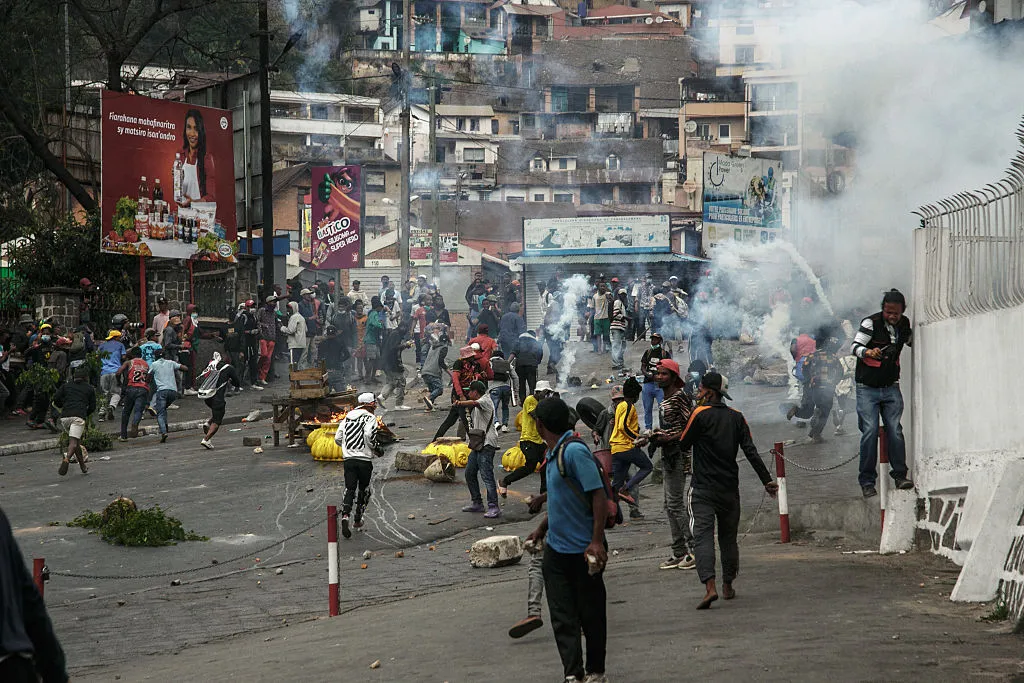
Tear gas clouds lingered like a stinging fog diring this week, in the sweltering heat of Antananarivo, the capital of Madagascar. Fists raised and faces concealed by scarves, young protestors clashed with police officers about water shortages and prolonged outages that had dried up taps for weeks. Northern city Antsiranana residents had taken to the streets on October 2 in a show of disapproval of President Andry Rajoelina’s leadership and a call for a nationwide strike. X users saw a video that went viral with the hashtag #GenZMada, which further amplified their voices. At least 22 people were murdered and over 100 were injured in the violence, which forced Rajoelina to dissolve his administration on October 6. In one of the poorest countries in Africa, where over 20% of the youth unemployment rate is above 25%, this was a tremendous concession. 12 This was the most recent eruption in a worldwide firestorm of Gen Z fury; it wasn’t merely an act of random disorder. Although they constitute 27% of the global workforce, those born between 1997 and 2012 are finding themselves unable to advance professionally due to the stagnant economy and the looming threat of automation. The air was charged with rebellion on October 3 in Casablanca, a coastal city in Morocco, as hundreds marched under the banner of GenZ 212, the country’s dialling code. In addition to national flags, they carried the Jolly Roger, a symbol of defiance against a “oppressive world government” in the anime One Piece, whose straw-hat skull they waved. Rocks were hurled at banks and luxury businesses in Salé were set ablaze by protesters. They were upset that stadiums were getting billions of dollars to host the 2030 FIFA World Cup even if hospitals were at capacity and youth unemployment was at 36%, meaning that one out of every five college grads was unemployed. Three zeros Protests have expanded to eighteen locations by October 6th, touching down from Rabat’s Andalusian gardens to Fez’s ancient medinas. A sudden surge of 250,000 users, able to outplan even the cops, swelled a discord server from 3,000 users the night before. 5 Even though Prime Minister Aziz Akhannouch said he would meet with the youth on October 2, their chants of “Health care first, we don’t want the World Cup” demonstrated their anger at the government’s betrayal. People under the age of 35 make up half of the population. 8 Images of burning police cars and children clambering over barriers went viral on X. A user made the remark, “From pixels to pavement—Gen Z’s turning ire into fire,” while the pirate flag fluttered in the midst of engulfed flames caused by flaming effigies. 11 24 The “Gen Z protests” started in early September in Nepal, and these eruptions in the Global South follow a flaming arc from there. A government was toppled in a hail of arson and carnage as a result of the protests, shocking even the organisers. The 26 social media platforms, including X, TikTok, and Discord, were banned on September 8, leading to an eruption in Kathmandu’s streets. The wealthy “nepo kids” residing in a city with an average annual salary of $1,400 were allegedly silenced by the restriction. 2 Smoke billowed from the Singha Durbar government building as a mob of protesters, including several minors as young as fifteen years old, stormed parliament. Before the power outage, their brief TikTok videos that debunked corruption allegations had millions of views. 9 Many people, including a 15-year-old who was shot in the face, were murdered in the violence, and Prime Minister K.P. Sharma Oli resigned by September 13. As a result, protest leaders are now vying for control in the upcoming March 2026 elections. 1 “One month later, Nepal’s Gen Z didn’t just protest—they rewrote the script.” was one of many thoughtful comments on X postings. After a year had passed, one user still showed joy in a video they shared, pledging to “make this beautiful country prosper.” 22 The wave grew in size: Young Kenyans continued to voice their displeasure with growing food costs and corruption in 2025, following the tax revolt of June 2024, prompting predictions of a “African Spring.” In response to disaster funding that were mismanaged, fifty members of Generation Z demonstrated in the Philippines and Indonesia, while thousands of young people in Peru and even Italy used internet memes as modern-day pitchforks during their marches in solidarity with Gaza. 10 7 Though the media presented it differently, 600 individuals were kettled by Berlin police on October 7. Some X users referred to this as a “forgotten Gen Z stand” against far-right activities. 27 The International Labour Organisation estimates that 289 million youths across the globe are not in education, employment, or training (NEETs). A “thoughtful” tsunami has swept over them, inspired by the Arab Spring but propelled by the likes of Wi-Fi and anime idols; their unemployment rate is three times that of adults. 1 The World Bank predicts that by October 2025, Africa will have become the epicentre of this storm. As fires rage through Madagascar, the continent’s Pulse report delivers a sobering diagnosis: Sub-Saharan Africa’s growth will increase from 3.5% to 3.8% this year, but the boom will be meaningless since only 100 million new jobs will be produced by 2035, despite 450 million more workers coming in. 41 45 Half of the African nations are in debt, and natural disasters like Morocco’s floods last year have only made matters worse. In Nairobi’s markets and Lagos’ booths, just 24% of young people labour for cash. The rest do it in the shadows. 43 According to the research, “simmering Gen Z ire” is an issue. The number of protests has increased 2.5 times in the past decade, and there will be 620 million more people of working age by 2050, accounting for 75% of the world’s net gain. Their goal is to create urban centres for textiles or tourism, as well as a “ladder of opportunity” by releasing the private sector, integrating skills with in-demand industries like green tech, and so on. 41 44 An annual total of 100,000 young people in Benin find employment in the private sector. Millions of people could be lifted out of poverty if we could scale it up and combine it with debt relief and trade treaties like AGOA, which might preserve 120,000 employment in Madagascar. 47 The fires are still burning brightly as we start the ninth of October. “The Gen Z reckoning is here—our politicians crumble after days; imagine a continuous onslaught,” read one Kenyan post on X, while another Nepali post rejects the idea of reruns, writing, “Gen Z says NO to hype, yes to real change.” This isn’t your average temper tantrum; it involves pirate flags amid Moroccan riots and tear gas in Malagasy alleys. One internet chant at a time, this tech-savvy, globally-connected generation is bringing down the establishment. Fix the jobs, pay for the futures, or face the flames—that is the message that the youth are sending to governments that are having problems with conversations and agreements. As 2025 takes its place in history as the “year of the protest,” the youth of Africa aren’t content to merely raise their voices; they are actively reshaping the continent via their fearless actions.