


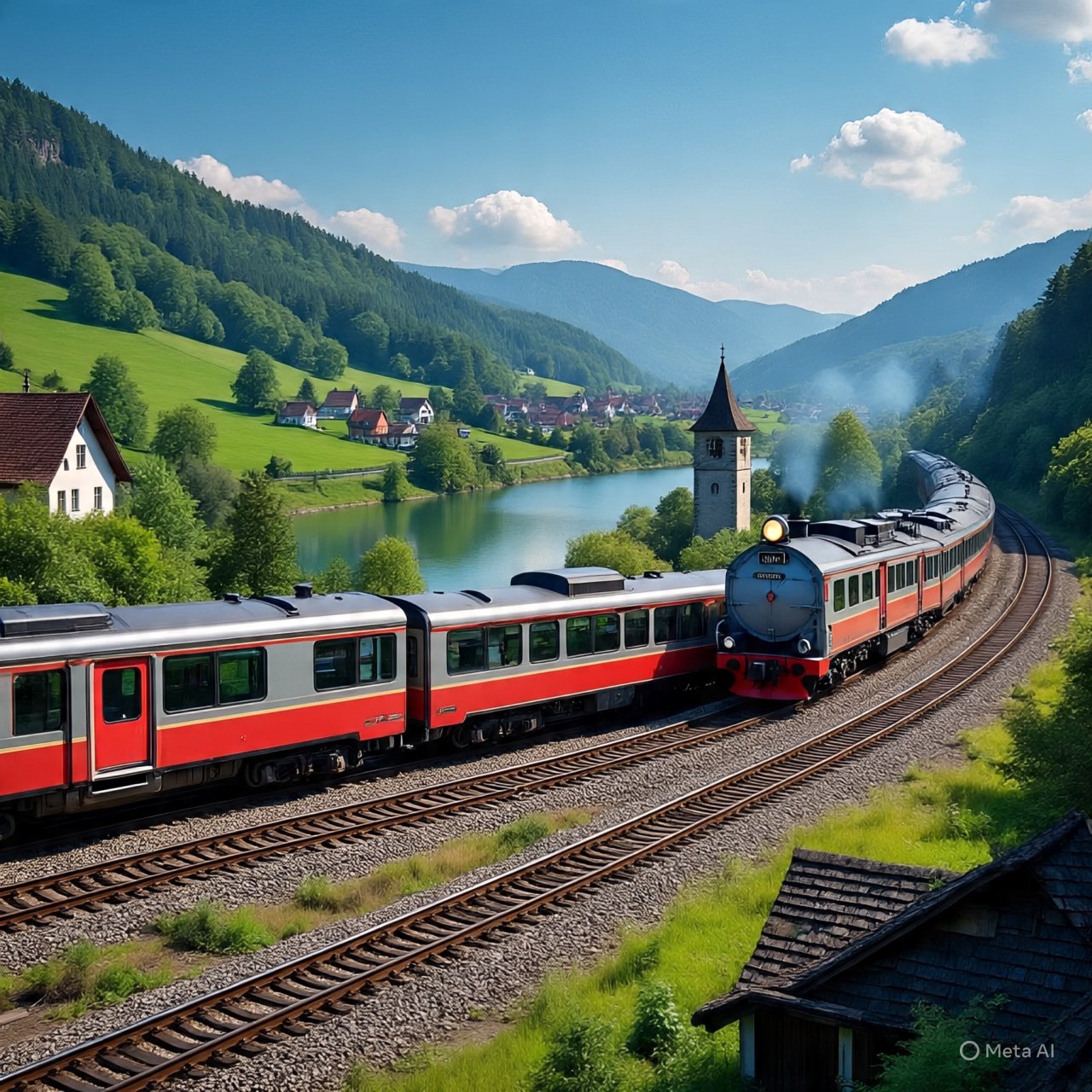
I happen to travel by train from Paris to Geneva, Switzerland in 2011. Traveling from Paris to Geneva by train aboard the high-speed TGV Lyria (3.5 hours from Gare de Lyon) unveils a breathtaking tapestry of landscapes. The journey begins amid the flat, sun-drenched plains of Burgundy, where world-famous vineyards—Chardonnay and Pinot Noir grapes—stripe the gentle hills in precise, emerald rows. Golden in autumn, lush in spring, these UNESCO-listed climats around Beaune and Dijon shimmer under the French sun, dotted with ancient stone villages and Romanesque churches.
Southward, the Saône River valley unfolds in verdant splendor, its banks lined with willows and grazing Charolais cattle. Medieval hamlets nestle in folds of forest as the train glides toward the Jura Mountains. Here, limestone cliffs tower over dense pine woods, waterfalls cascading into misty gorges. Snow-dusted peaks loom in winter; wildflower meadows burst in summer.
Crossing into Switzerland near Bellegarde, the route skirts Lac du Bourget’s sapphire waters before revealing Lake Geneva’s alpine panorama. The Lavaux vineyards—terraced like giant staircases—tumble toward the lake, framed by the snow-capped Alps. Eagles soar; deer graze. From Burgundy’s storied vines to Geneva’s majestic lakeshore, this rail journey is a moving gallery of Europe’s finest scenery.
But it is not enough. Europe and US must be explored via train journey. It is unique experience to see most beautiful continents of the world.
But where should you go—Europe’s ancient valleys or America’s sprawling wilderness?
Let’s ride both sides of the Atlantic and see which scenic train journey is more enjoyable.

Europe: Heritage on Every Curve
Imagine a locomotive older than a century, puffing steam across a Yorkshire moor. That’s the Keighley & Worth Valley Railway—a 5-mile ribbon of nostalgia straight out of a Brontë novel. Tourists don’t just ride; they time-travel. Vintage carriages creak past stone villages where sheep outnumber people. In October, the 1940s Weekend turns platforms into wartime film sets—think tweed suits, victory rolls, and swing dancing between trains.
Hop continents without leaving your seat on the Vigezzina Centovalli. This Swiss-Italian narrow-gauge line slaloms through 83 bridges and 31 tunnels, popping out into valleys where chestnut trees glow like lanterns. Stop in Rasa, a car-free hamlet reachable only by cable car. Locals roast chestnuts over open fires while you sip vin brulé—the original slow food moment.
European Edge: Heritage steam trains + walkable villages + harvest festivals = immersive cultural travel.
America: Wild & Wide Open
Now cross the pond. The Great Smoky Mountains Railroad in North Carolina doesn’t whisper—it roars. Diesel engines haul open-air gondola cars through the Nantahala Gorge, where the French Broad River flashes silver between cliffs draped in hickory gold. Moonshine tastings onboard? Yes. Bear sightings from your seat? Possible.
Further north, the Cumbres & Toltec Scenic Railroad in Colorado/New Mexico is pure Wild West drama. At 10,000 feet, aspens shimmer like coins in sunlight. The train crawls along ledge tracks carved by 1880s labourers—every curve a postcard. In autumn, elk bugling echoes through the valleys, and the onboard storyteller swears the ghosts of gold miners ride along.
American Edge: Epic scale + wildlife encounters + open-air cars = raw, untamed nature.
Book Europe if: You crave story-rich travel—where every station has a 200-year-old pub and the conductor quotes poetry.
Travel to USA if you want heart-pounding vistas—where the train hugs cliff edges and the only soundtrack is wind and whistling elk.
Or—plot twist—do both. Fly into London, ride the Keighley steam train, then jet to Asheville for the Smokies in gondola glory. Call it the Transatlantic Leaf Peeping Challenge.