

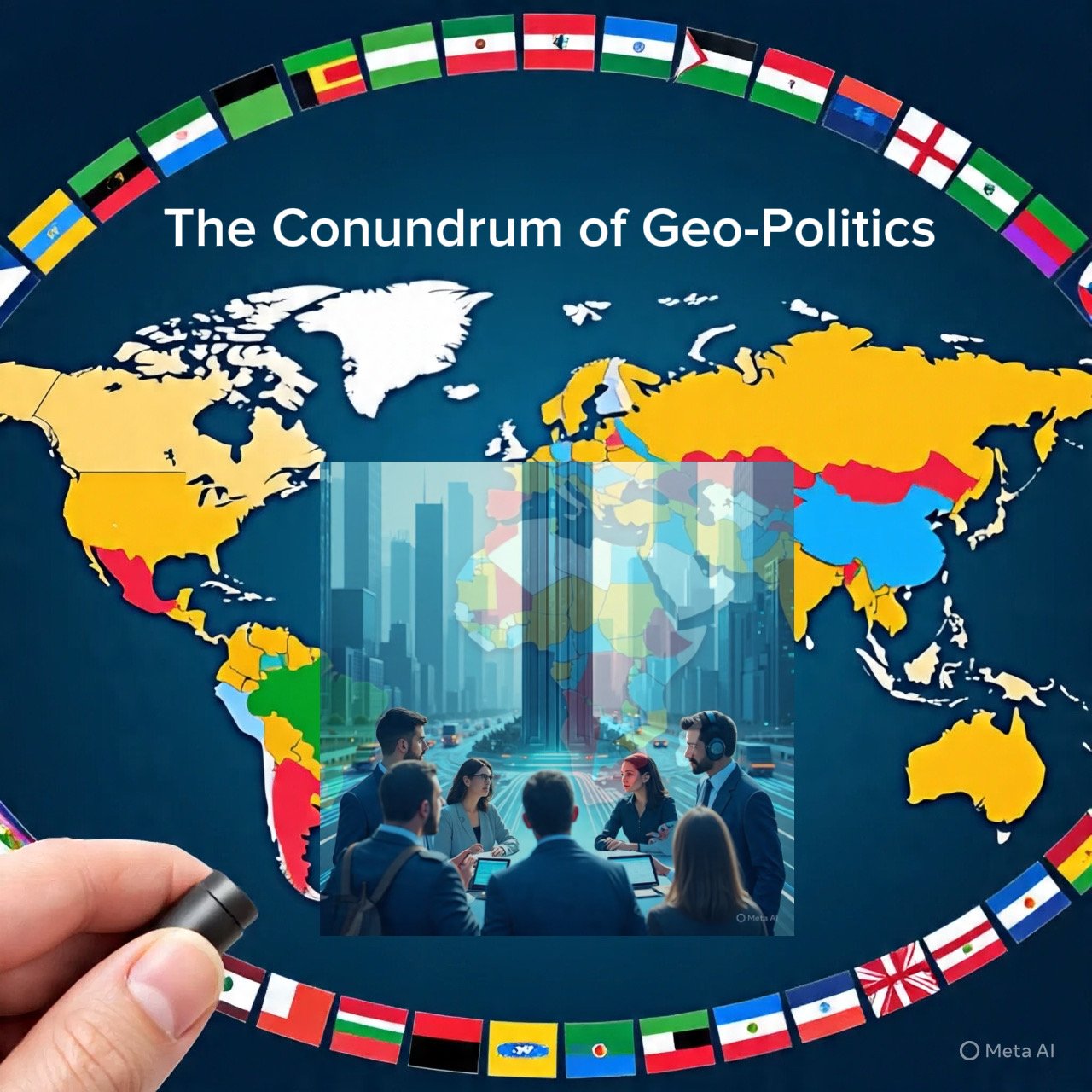
Artificial intelligence could be humanity’s greatest cooperative project—a tool for curing diseases, managing climate systems, and democratizing knowledge. Yet it is rapidly being weaponized, militarized, monopolized, and turned into an instrument of surveillance and social control. This duality lies at the heart of our modern dilemma: human innovation constantly reshapes our relationship with nature and each other, creating profound opportunities alongside perilous new problems.
Throughout history, certain events have acted as hinges of destiny, irrevocably altering humanity’s trajectory. The rise of artificial intelligence is one such revolution. It presents the ultimate dual-use dilemma: every tool of creation can become a tool of domination. But a choice for domination ensures the tool’s full potential remains forever unrealized.
Today’s world stands at crossroads. Rapid advancements in AI and science offer unprecedented potential for collective human flourishing, while geopolitics retreats into a corrosive, coercive competition that treats every gain as another’s defeat. This is not strategy—it is a slow suicide of our common future.
In game theory, a zero-sum game is one where resources are fixed: my win is your loss. In sports or elections, this framework is natural. But applied to international relations, economics, or technology, a zero-sum mindset is a catastrophic misreading of reality. Yet this is precisely what we see unfolding: great powers carve spheres of influence, using hybrid warfare—cyberattacks, economic coercion, disinformation—to maximize their advantage at the direct expense of others. Smaller nations are squeezed into allegiance, their sovereignty eroded. Global challenges like climate change are pushed aside in favor of tactical dominance.
This is more than a failure of diplomacy; it is a failure of imagination. By viewing the world through a lens of fixed pies and inevitable conflict, we shrink the horizon of the possible. We are witnessing the abandonment of history’s hard-won lessons. The “shadow of the future”—the incentive to cooperate for long-term gain—is being eclipsed by short-term gambits for advantage. As trust collapses and institutions built for dialogue weaken, we are playing a single-round game in an iterative world. In such a game, everyone ultimately loses.
This pattern is not new. History is punctuated by revolutions that reshaped the human condition, each carrying a complex legacy of creation and destruction.
· The Agricultural Revolution (c. 10,000 BCE): The shift from nomadic life to settled agriculture led to surplus food, population growth, and the birth of cities, writing, and states—the foundation of civilization itself. Yet it also brought social stratification, epidemic diseases, and environmental alteration.
· The Columbian Exchange (1492 onward): The transference of plants, animals, diseases, and cultures between the Old and New Worlds created the first globalized system. It reshaped diets and economies, but also brought genocide, pandemics, and slavery. It underscores that unintended consequences can dwarf original intentions, revealing the deep, often painful, roots of globalization.
· The Industrial Revolution (c. 1760–1840): The shift to machine manufacturing unleashed unprecedented growth, technological progress, and urbanization. It also created brutal labor conditions, massive pollution, and destabilizing social inequalities. It highlights the critical need for ethical frameworks to manage disruptive change and distribute its benefits justly.
· The World Wars (20th Century): These industrial-scale conflicts resulted in over 80 million deaths, destroyed empires, and gave rise to the superpower rivalry and nuclear age. They taught that nationalism, militarism, and failed diplomacy lead to catastrophic collapse. In response, they spurred the creation of international institutions and human rights frameworks, confirming the terrifying responsibility that comes with world-altering technology.
· Decolonization: The rapid dissolution of European empires redrew the world map and affirmed the universal desire for self-determination. Yet it also left a legacy of arbitrary borders, economic dependency, and post-colonial struggles, proving that political independence without economic and cultural justice can lead to enduring instability.
· The Digital Revolution: The rise of computers and the internet has created a hyper-connected world, transforming economics, social interaction, and warfare. It demonstrates that connectivity is power—a tool for both empowerment and control, amplification and fragmentation—demanding new forms of literacy and ethical consideration.
From these echoes, key lessons emerge: No society develops in true isolation; ideas and consequences always travel. Philosophies and technologies often have greater long-term impact than battles or leaders. Massive disparities in wealth and power are a primary engine of historical conflict. While vast impersonal forces shape history, the choices of individuals and collectives in moments of crisis determine the final direction.
Coexistence is not naive idealism—it is a strategic necessity. History shows that cooperation often emerges from painful stalemates or shared crises. Climate disasters, pandemics, and resource scarcities do not respect borders; they will force collaboration even among rivals.
Smaller states are already seeking new forms of agency through hedging, non-aligned blocs, and regional partnerships. But without buy-in from major powers, these efforts remain fragile. What’s needed is a recalibration of incentives—where cooperation is tangibly rewarded, and defection carries credible costs.
The shift begins with reframing the narrative. Our global system must move:
· From sovereignty as isolation to sovereignty as responsibility.
· From security as dominance to security as mutual resilience.
· From technology as a battleground to technology as a commons.
Leaders must recognize that in an interconnected world, the most enduring victories are those that expand the pie, not just seize a larger slice. Fairness—whether in 50/50 splits or equitable burden-sharing—is not charity; it is the bedrock of a sustainable order.
Zero-sum games are relics of a scarcer, more fragmented past. Today, our challenges are planetary, and our tools are unprecedented. To cling to a mindset of subtraction—where every gain requires a loss—is to choose collective diminishment.