

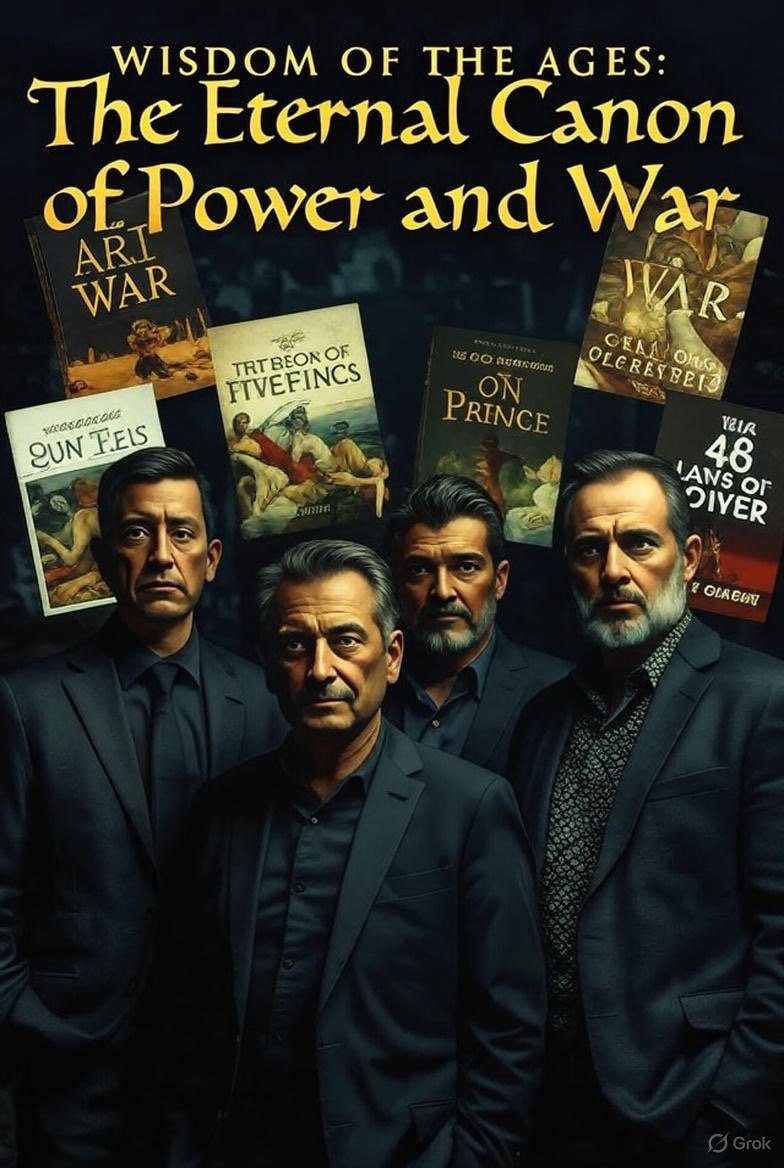
Robert Greene’s The 33 Strategies of War (2006), Miyamoto Musashi’s The Book of Five Rings (1645), Carl von Clausewitz’s On War (1832), Niccolò Machiavelli’s The Prince (1532), and Sun Tzu’s The Art of War (circa 5th century BCE) forge a pentagon of lethal mastery—five blades tempered across millennia, each carving conflict into art through intellect, spirit, friction, deception, and void. Greene, the modern swordsman, fuses Musashi’s solitary duels, Sun Tzu’s flowing water, Clausewitz’s dialectical thunder, and Machiavelli’s fox-and-lion cruelty into blood-drenched stories that hurl ancient maxims onto fields of screaming steel. These lightning anecdotes—samurai on rain-slick bridges, elephants on ice, banquets turned charnel houses—set the pentagon ablaze, revealing how Musashi’s “cut the enemy in one timing,” Sun Tzu’s formlessness, Clausewitz’s culminating strike, Machiavelli’s virtu, and Greene’s psychological death-ground transmute theory into living slaughter.
Deception is the first cut: “All warfare is based on deception,” Sun Tzu whispers; strike with absolute void, Musashi demands; appear virtuous while gutting mercy, Machiavelli; mask intent amid friction, Clausewitz; weave hypnotic shadows, Greene. Normandy 1944: rubber tanks bobbed like corpses at Pas-de-Calais, phantom radios crackled lies, Patton strutted over ghost legions. Hitler froze his Panzers while Omaha bled. Sun Tzu’s “seem unable,” Musashi’s feigned opening, Machiavelli’s false mercy, Clausewitz’s miscalculation exploited, Greene’s shadows-within-shadows—one stroke, half the expected dead.
Self-mastery is the second cut: know yourself and foe, Sun Tzu; train until the sword disappears, Musashi; war is three-fourths moral, Clausewitz; be lion and fox, Machiavelli; declare war on your own mind, Greene. Ganryu Island 1612: Musashi arrived late, sun at his back, wooden oar carved into a longer blade. Sasaki Kojirō’s “Turning Swallow” slashed air—Musashi’s single downward stroke split skull to breastbone. No second cut. Musashi’s void-mind, Sun Tzu’s self-knowledge, Clausewitz’s moral force, Machiavelli’s calculated cruelty, Greene’s inner polarity—one breath, one kill.
Adaptability is the third cut: flow like water, Sun Tzu; become the mountain or the shadow, Musashi; genius overrides friction, Clausewitz; discard obsolete tools, Machiavelli; fight not the last war, Greene. Shaka Zulu snapped throwing spears, forged stabbing iklwa, drilled impis into encircling horns. Gqokli Hill 1818: 20,000 volleys absorbed, then barefoot sprint—no pause, no mercy—7,000 corpses in minutes, field a red river. Sun Tzu’s terrain mastery, Musashi’s direct adaptation, Clausewitz’s improvisation, Machiavelli’s ruthless innovation, Greene’s guerrilla-mind obliterating tradition.
Desperate ground births demons: throw troops where escape dies, Sun Tzu; cross the ford of death, Musashi; absolute war demands total exertion, Clausewitz; fortune favors audacity, Machiavelli; burn bridges for focus, Greene. Austerlitz 1805: Napoleon bared his right in freezing fog, baiting Allies into lunge. Sun rose—hidden corps slammed their center like divine judgment. Coalition shattered in four hours. Sun Tzu’s no-escape fury, Musashi’s death-ground timing, Clausewitz’s culminating point, Machiavelli’s bold virtu, Greene’s death-ground genius—legend forged in frost and blood.
Terror is the fourth cut: invade formless as ghosts, Sun Tzu; strike the enemy’s spirit first, Musashi; moral forces decide, Clausewitz; better feared than loved, Machiavelli; chain-reaction paranoia, Greene. Genghis Khan razed Bukhara 1220, released survivors to howl apocalypse—cities flung gates open hundreds of miles away. Sun Tzu’s psychological void, Musashi’s spirit-breaking, Clausewitz’s shock, Machiavelli’s pragmatic betrayal, Greene’s terror networks.
Ruthless statecraft is the fifth cut: Cesare Borgia, Machiavelli’s perfect prince. Romagna 1502: appointed brutal Ramiro d’Orco to crush rebellion, then publicly quartered him—absorbing hatred, claiming mercy. Rebellious lords invited to Senigallia “reconciliation banquet”—garroted mid-feast, bodies dumped in snow. Sun Tzu’s deception without form, Musashi’s single decisive stroke, Clausewitz’s decisive blow, Machiavelli’s “caress or annihilate,” Greene’s seem-to-work-for-others while advancing your own.
Grand strategy is the final cut: holistic campaigns, Sun Tzu; see the entire mountain, Musashi; war serves politics, Clausewitz; maintain the state, Machiavelli; chain battles toward destiny, Greene. Julius Caesar at Alesia 52 BCE: double walls trapped Vercingetorix inside, 250,000 relief outside. Legions spun back-to-back, crushed both in one afternoon—Gaul starved psychologically before physically. Sun Tzu’s break resistance without fighting, Musashi’s total perception, Clausewitz’s trinity aligned, Machiavelli’s indirect root-severance, Greene’s ultimate indirection.
Hannibal’s elephants roared over frozen Alps 218 BCE—half his army devoured by avalanches, survivors became demons. Cannae: center crumbled like bait, cavalry jaws snapped shut—50,000 Romans pulped by sunset. Sun Tzu’s indirect path, Musashi’s one-timing envelopment, Clausewitz’s center-of-gravity annihilation, Machiavelli’s calculated cruelty, Greene’s blitzkrieg fused into Rome’s nightmare.
These thunderbolts—Musashi’s oar splitting skull under blinding sun, Borgia’s blood-soaked snow banquets, elephants on ice, rubber armies haunting Hitler, fog exploding into divine suns—ignite the pentagon: Sun Tzu the ancient oracle, Musashi the void-samurai, Clausewitz the dialectical titan, Machiavelli the amoral surgeon, Greene the vivid resurrector. In 2025’s drone swarms, cyber ghosts, and digital assassinations, they roar as one: friction, fear, fog, and flesh bow only to minds forged in five rings of fire. Greene doesn’t echo the masters—he hands us their blades, reborn and screaming, for an age where power strikes in absolute void, before the enemy even draws breath.