The ongoing military conflict between the United States and Iran has metastasized into a profound global economic crisis, fundamentally threatening the stability of the emerging international order. At the heart of this economic dislocation is the weaponization of global trade routes, specifically the dual blockades of the Strait of Hormuz. Iran initially choked off neutral shipping, prompting President Donald Trump to impose a counter-blockade on April 13th targeting traffic to and from Iranian ports and coastal areas. This unprecedented restriction on one of the world’s most vital maritime chokepoints has triggered cascading shocks across energy, agriculture, and global capital markets, while simultaneously accelerating the fracture of the rules-based international system.
The economic devastation is the primary lever in the ongoing, albeit fragile, peace negotiations between Washington and Tehran. Operating under a highly volatile ceasefire, both sides are attempting to use economic strangulation to extract maximum concessions. The United States’ primary objective is to permanently cripple Iran’s nuclear capabilities to prevent a broader regional arms race. American negotiators are demanding a 20-year moratorium on uranium enrichment and insisting that Iran’s stockpile of over 400kg of near-weapons-grade uranium be shipped out of the country. Conversely, Iran is negotiating from a position of severe economic desperation, battered by a debased currency, war damage, and annual inflation exceeding 50%. Tehran’s singular focus is comprehensive financial relief, demanding the removal of both primary and secondary US sanctions to unfreeze billions in foreign banks, while insisting on down-blending its uranium locally to preserve its national sovereignty.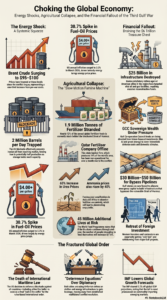
The immediate economic fallback of the Hormuz closure has been characterized by the International Energy Agency as the “most severe oil-supply shock in history”. Brent crude prices have surged and remain volatile between $95 and $100 a barrel. This energy shock has derailed global macroeconomic stabilization efforts, pushing US annual inflation up to 3.3% in March and forcing American motorists to pay 29% more for gasoline. The inflationary pressure has effectively trapped the US Federal Reserve, dashing market hopes for interest rate cuts and complicating the tenure of prospective Fed Chair Kevin Warsh. In Europe, the crisis is severely compounded by a massive deficit in refined products; the continent relies on the Middle East for half of its 1.2 million barrels a day of imported diesel, causing price premiums over crude to balloon to $60 for diesel and $100 for jet fuel.
Beyond energy, the blockade threatens a catastrophic collapse in global agriculture. The Gulf region supplies 30% to 35% of globally traded urea and 20% to 30% of ammonia. Currently, nearly 1.9 million tonnes of vital fertilizer are trapped behind the blockade, causing global prices for urea and ammonia to spike by 65% and 40%, respectively. This shock is particularly devastating for India, which relies on the Gulf for 41% of its urea imports to sustain the agricultural sector that employs over half its population. After New Delhi explicitly denied paying a fee to safely transit Iranian waters, the US Central Command announced it would impartially enforce its counter-blockade against any vessels—including Indian ships—that had passed through Iranian coastal territory. Consequently, Indian officials are now scrambling to secure vastly more expensive alternative supplies from Russia and China, an economic crisis that analysts predict will drive Indian food-price inflation to a staggering 11%.
Because the fertilizer shortage coincides with crucial planting seasons and an impending “super” El Niño weather pattern that threatens severe droughts and floods, global crop yields are expected to plummet. The United Nations World Food Programme warns that if the strait remains closed until mid-year, an additional 45 million people will face starvation, effectively turning the maritime blockade into a “slow-motion famine machine”. The economic toll in the Global South is further exacerbated by the collapse of vital remittance networks. Over 20 million migrants from South and Southeast Asia work in the Gulf. The war has forced tens of thousands of blue-collar workers to flee, threatening a massive contraction in remittances that typically account for $32 billion annually in Bangladesh and a quarter of Nepal’s entire GDP.
In global financial markets, the conflict is rapidly draining the $6 trillion treasure chests of the Gulf states’ sovereign wealth funds. These funds, which have recently poured hundreds of billions of dollars into global artificial intelligence startups, private credit, and foreign real estate, are now being forced to pivot their capital inward. Approximately $25 billion in oil and gas infrastructure has already been destroyed by retaliatory strikes, requiring massive domestic reinvestment alongside a potential $30 billion to $50 billion needed for new bypass pipelines. Consequently, mega-projects like Saudi Arabia’s Mukaab and The Line are seeing contract cancellations, and foreign contractors are retreating as regional instability stanches global capital flows.
The conflict is accelerating a profound realignment of the emerging global order, solidifying an “Axis of Resistance” where Russia and China present a united front in support of Iran. China’s economic and strategic reactions reveal deep anxieties about the shifting global landscape. Domestically, Beijing is protecting its own agricultural sector by curbing fertilizer exports amid the global shortage. Strategically, Chinese officials are quietly alarmed by the precedent set by the unilateral American blockade of Hormuz, fearing that a similar tactic could eventually be deployed by the US Navy to choke off the Strait of Malacca in the event of a future conflict in the Pacific.
Ultimately, the economic fallout of the US-Iran war is reshaping the global order by eroding the foundational principles of international commerce. Military and legal analysts note that the weaponization of the Strait of Hormuz and the unilateral US blockade represent “another nail in the coffin for any pretence that there is such a thing as a rules-based order or international law”. Furthermore, the economic coercion heightens the risk of an unstoppable nuclear arms race, with the head of the International Atomic Energy Agency warning that if Iran crosses the nuclear threshold, a domino effect among neighboring states is virtually inevitable. As nations navigate unprecedented energy inflation, agricultural failure, and the fracturing of maritime law, the economic scars of this conflict will dictate the trajectory of global geopolitics for decades.
About the Author