Abstract
In April 2026, Pakistan emerged as the primary mediator in the most significant diplomatic engagement between the United States and Iran since the 1979 Islamic Revolution. By hosting the Islamabad Talks (April 11–12, 2026) and facilitating a two-week ceasefire that halted active hostilities and temporarily reopened the Strait of Hormuz, Islamabad achieved an unprecedented feat of conflict mediation — at a moment when the global economy urgently needed relief from the energy and trade disruption caused by the war. This paper analyses the structural conditions that enabled Pakistan’s pivot, examines the architecture of the mediation process, and assesses what has been accomplished. The paper argues that the Islamabad Process represents a historically significant transformation in Pakistan’s strategic role, that the conditions for a durable agreement are more promising than the breakdown of the first round suggests, and that the international community has strong reasons to support Pakistan’s continued leadership of this diplomatic track.
1. Introduction: The Unexpected Mediator
On February 28, 2026, the United States and Israel launched coordinated air strikes against Iran, killing Supreme Leader Ali Khamenei and triggering a regional war. Iran responded by closing the Strait of Hormuz, through which approximately 20 percent of global oil and gas supplies pass, sending energy markets into crisis. Within six weeks, Pakistan — a country more routinely associated with internal insurgency, fiscal fragility, and fraught relations with its neighbours — had positioned itself as the primary communication channel between Washington and Tehran, facilitated a ceasefire, and hosted the highest-level US–Iran direct talks since 1979.
The policy literature on South Asian geopolitics has long tended to treat Pakistan through the lens of accumulated deficits: a fiscally constrained economy, a civilian government periodically under institutional pressure, and a foreign policy defined by the tensions of its simultaneous partnerships with the United States, China, and Saudi Arabia against the backdrop of its long shared border with Iran. Against this backdrop, Pakistan’s emergence as the architect of the “Islamabad Process” constitutes an event that demands serious analytical attention on its own terms — one that should neither be dismissed as transient nor overstated as a permanent structural shift.
This paper proceeds in five substantive sections. Section 2 reconstructs the structural conditions that made Pakistan a viable mediator in this conflict. Section 3 provides a detailed account of the mediation architecture and the Islamabad Talks themselves. Section 4 assesses what Pakistan has achieved and why those achievements matter for a world urgently seeking relief from energy and economic disruption. Section 5 examines the path to consolidating the Islamabad Process. Section 6 offers conclusions and near-term scenario projections, with attention to the global stakes of a successful outcome.
2. The Structural Conditions of Pakistan’s Mediation Role
2.1 The Multipolar Vacuum and the Failure of Traditional Intermediaries
The 2026 Iran conflict exposed a fundamental gap in the architecture of international mediation. The actors who might conventionally have facilitated US–Iran communications were each structurally limited. The European troika — France, Germany, and the United Kingdom — lacked credibility in Tehran following years of JCPOA non-implementation. Qatar, while possessing longstanding US military presence and Iranian ties, was perceived in Washington as too closely aligned with Tehran. Oman, the historic back-channel for US–Iran communication, had reduced its diplomatic footprint. China, while broadly supportive of de-escalation, was viewed with significant scepticism in Washington as insufficiently neutral.
The resulting mediation vacuum was noted by regional analysts who observed that intra-GCC disagreements over a ceasefire framework and a diplomatic pathway to Iran had “created the need for exactly that kind of actor” that Pakistan represented — one with credible ties to both sides, but formal membership of neither bloc. Pakistan’s specific position was rooted in a convergence of geographic, historical, and relational factors that no other single state could replicate in full.
2.2 The Geometry of Pakistan’s Relationships
Pakistan’s utility as a mediator derived from a rare simultaneous credibility across the principal parties to the conflict:
United States: Pakistan’s relationship with the Trump administration had evolved substantially since Trump’s first term. A brief military confrontation with India in 2025, during which Pakistan publicly credited Trump’s intervention for de-escalation, rebuilt diplomatic goodwill in Washington. Pakistan’s significant declared reserves of rare earth minerals had also generated renewed economic interest. Field Marshal Asim Munir’s direct communication with President Trump on March 22–23 proved pivotal, contributing to a five-day pause on US strikes against Iranian energy infrastructure.
Iran: Pakistan shares a nearly 1,000-kilometre land border with Iran. Deep religious and cultural ties — particularly given Pakistan’s significant Shia population — gave Islamabad a form of social proximity that purely strategic partners could not replicate. Both President Trump and Iranian Foreign Minister Abbas Araghchi publicly praised Prime Minister Shehbaz Sharif and Field Marshal Munir by name. Araghchi stated that Iran had accepted the ceasefire “in response to the brotherly request of PM Sharif,” a signal of genuine relational trust that went beyond formal diplomatic positioning.
Saudi Arabia: A bilateral mutual defence pact concluded in September 2025 made Pakistan a formal security partner of Riyadh. Pakistan navigated this relationship carefully, expressing solidarity with Saudi Arabia while ensuring that its treaty obligations did not foreclose its engagement with Tehran.
China: Pakistan established an effective diplomatic conduit with Beijing, resulting in a joint Pakistan–China five-point peace initiative issued on March 31. The involvement of China — a country with deep economic ties to Iran and significant weight in Tehran’s strategic calculus — lent additional credibility to Pakistan’s mediation framework.
This geometry — credible relationships with Washington, Tehran, Riyadh, and Beijing simultaneously — is what enabled Pakistan to, in the words of one contemporaneous analysis, “speak to all sides, without formally belonging to any.” It is a configuration that no other regional or middle power could claim in full at this specific moment.
2.3 Pakistan as a Nuclear-Armed Regional Mediator
A dimension of Pakistan’s mediating role that distinguishes it from smaller state intermediaries is its status as a declared nuclear power. In a conflict whose core dispute concerned Iran’s nuclear programme, Pakistan’s experience as a state that has navigated the transition from conventional to nuclear deterrence — and which exists in a complex strategic environment involving multiple nuclear-armed neighbours — gave it a form of contextual understanding that non-nuclear mediators could not claim. Pakistan is one of very few states in the world with credible diplomatic relationships across Washington, Beijing, Tehran, and Riyadh simultaneously, while itself holding nuclear status. This gives its mediation a different weight in Tehran’s perception: Islamabad is not a distant observer, but a regional state whose own security calculus is shaped by many of the same variables.
2.4 The 1971 Precedent and Diplomatic Institutional Memory
Pakistan’s role as a diplomatic intermediary has historical precedent. In 1971, President Yahya Khan facilitated Henry Kissinger’s secret visit to Beijing, enabling the opening of US–China relations — a role that went unacknowledged publicly for years. The current engagement builds on this institutional memory: Pakistan’s diplomatic and military establishment has, across decades, developed a quiet proficiency in back-channel communication that often contrasts sharply with its more turbulent public political narrative. The 2026 mediation represents both an activation and, critically, a visible and publicly acknowledged deployment of this historical competency.
3. The Architecture of the Islamabad Process
3.1 Phases of Engagement
The mediation process unfolded across four identifiable phases, each involving distinct actors, diplomatic instruments, and objectives.
| Phase | Period | Key Actions | Outcome |
| I: Coalition Building | March 12–29 | Sharif–Munir visit to Jeddah; quadrilateral FM meetings in Riyadh (Mar 19) and Islamabad (Mar 29) with Saudi, Turkish, and Egyptian counterparts | Regional alignment achieved; Pakistan positioned as hub mediator |
| II: Shuttle Diplomacy | March 22–April 5 | Munir speaks directly to Trump (Mar 22–23); Pakistan delivers US 15-point proposal to Tehran (Mar 25); Iran issues 5-point counter; Pakistan–China joint 5-point initiative (Mar 31) | Competing frameworks tabled; communication channel operational |
| III: Ceasefire Facilitation | April 6–8 | Intensive back-channel communications; Pakistan Air Force escorts Iranian delegation to Islamabad; Trump announces ceasefire crediting Sharif and Munir | Two-week ceasefire agreed; Strait of Hormuz temporarily reopened |
| IV: Islamabad Talks | April 11–12 | 21-hour direct talks at Serena Hotel; three rounds (first indirect, second and third direct); US led by VP Vance; Iran by Speaker Ghalibaf and FM Araghchi | No agreement reached; ceasefire holding; “Islamabad Process” framing adopted |
3.2 The Islamabad Talks: What Happened
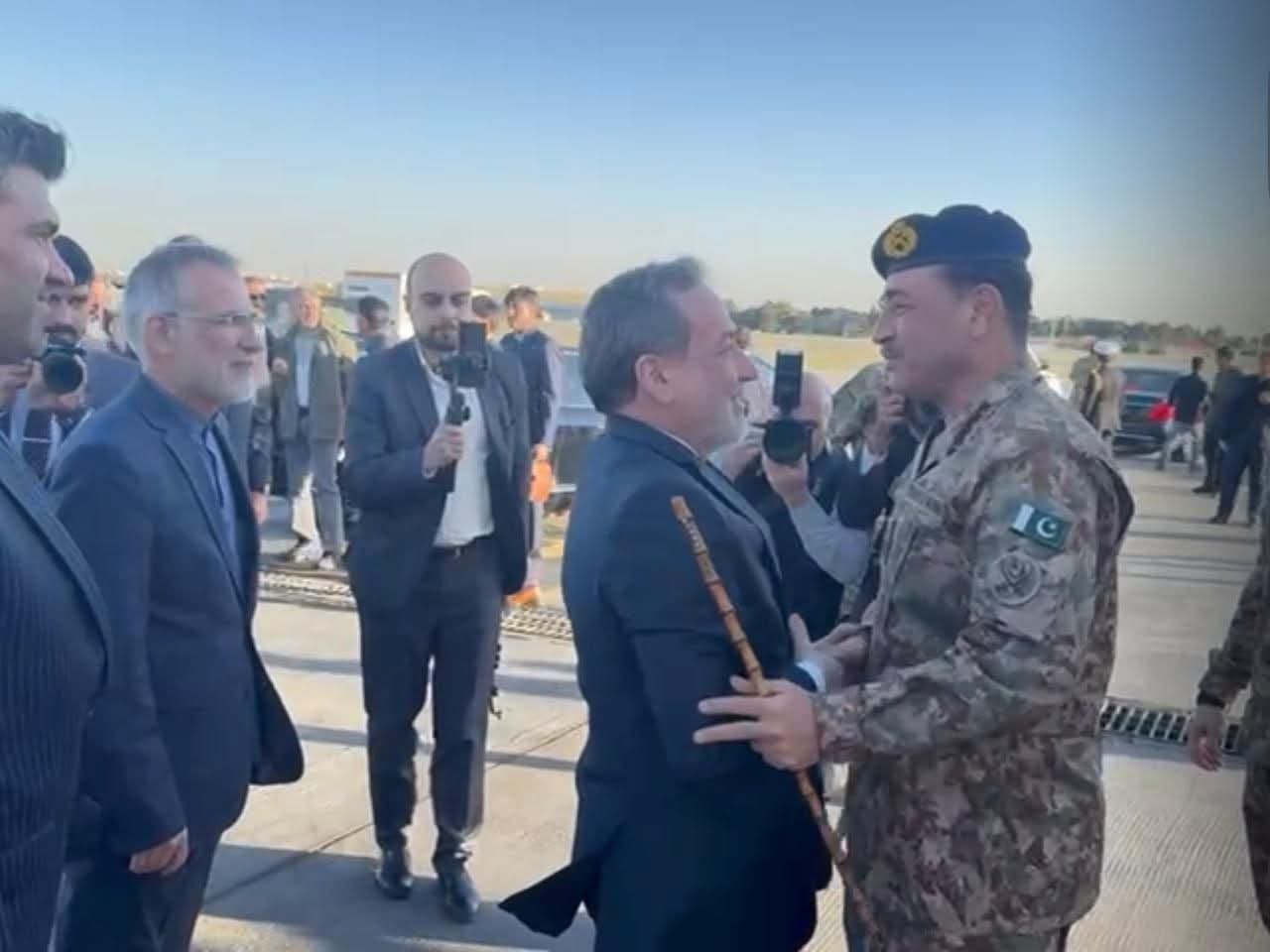
The Islamabad Talks of April 11–12 constituted a historically unprecedented event: the first direct, high-level US–Iran engagement since 2015 and the first face-to-face talks since the 1979 Islamic Revolution, held on Pakistani soil. The negotiations lasted 21 hours across three rounds. The US delegation of approximately 300 was led by Vice President JD Vance, alongside Special Envoys Steve Witkoff and Jared Kushner. The Iranian delegation of approximately 70 was led by Parliamentary Speaker Mohammad Bagher Ghalibaf and Foreign Minister Abbas Araghchi. The Pakistani mediating team was led by Prime Minister Shehbaz Sharif, Field Marshal Asim Munir, and Deputy Prime Minister and Foreign Minister Ishaq Dar.
The core unresolved issues were structural in nature. The United States made a commitment on denuclearisation its primary demand: Vance stated publicly that Washington required a “fundamental commitment” from Tehran not to develop nuclear weapons, including the removal of enriched material. Iran rejected full denuclearisation while insisting on its right to a civilian nuclear programme, including uranium enrichment. Secondary impasses involved the status of the Strait of Hormuz, Iranian demands for war reparations and security guarantees, the ongoing Israeli campaign in Lebanon, and Iran’s demand for international recognition of its sovereignty over the Strait.
Iranian Parliamentary Speaker Ghalibaf’s public statement after the talks was notably revealing. He stated the two sides had come “inches away from an MoU” before accusing the US of maximalism and shifting goalposts. This was, as contemporaneous analysis noted, the clearest public signal yet that the parties had come closer to a formal agreement than either government had previously acknowledged. It also clarified that the breakdown was not the result of Pakistani mediation failing, but of the parties’ own structural intransigence. The mediator had successfully engineered proximity; what remained absent was the political will of the principals.
3.3 The Aftermath and the “Islamabad Process”
Pakistan’s response to the breakdown was diplomatically astute. Rather than framing the outcome as a failure of its mediation, Islamabad recast the engagement as the initiation of an ongoing “Islamabad Process” — an institutionalised diplomatic track rather than a single event. Pakistani officials began using this terminology consistently in public briefings and international engagements. FM Dar stated that Pakistan “has been and will continue to play its role to facilitate engagements and dialogue between the Islamic Republic of Iran and the United States.”
Prime Minister Sharif subsequently embarked on a four-day diplomatic tour to Saudi Arabia, Qatar, and Turkey, consolidating regional support for a second round of talks before the ceasefire expires. UN Secretary-General Guterres, meeting with Pakistan’s Deputy Prime Minister, stated it was “highly probable” that ceasefire talks would restart. President Trump stated on April 14 that talks in Islamabad were “more likely,” signalling continued US confidence in the venue and its host.
4. What Pakistan Has Achieved
4.1 A Record of Historic Firsts
Pakistan’s mediation record as of April 16, 2026, stands as a series of historic firsts that would have been dismissed as improbable only months ago. Three accomplishments in particular define the scale of what Islamabad has delivered for a world gripped by energy insecurity and economic anxiety.
First, Pakistan successfully facilitated the April 8 two-week ceasefire between the United States and Iran. This is not a trivial achievement. The ceasefire halted active hostilities, temporarily reopened the Strait of Hormuz, and created the diplomatic space that made the Islamabad Talks possible. Both Trump and Araghchi credited Sharif and Munir by name — an unusual degree of public acknowledgement from both sides simultaneously.
Second, Pakistan hosted the first direct, high-level US–Iran engagement since the Islamic Revolution. This is historically significant regardless of outcome. A country that was not at the table for the 2015 JCPOA or the Abraham Accords positioned itself at the centre of the most consequential diplomatic effort in the region in decades. The Islamabad Talks were, as one analyst described, the first time Pakistan had “simultaneously managed active conflict mediation between two adversaries under ongoing military escalation without direct contact between them.”
Third, Pakistan’s post-breakdown diplomatic posture — reframing failure as process, continuing shuttle diplomacy, and securing endorsement from the UN Secretary-General and continued US interest in Islamabad as a venue — demonstrates institutional resilience and strategic communication capacity that many did not expect.
5. The Path to a Durable Islamabad Process
5.1 Building on a Strong Foundation
The conditions for consolidating the Islamabad Process into a recognised and durable diplomatic institution are considerably more favourable than the post-April 12 headlines suggest. The fact that both the United States and Iran returned from the talks praising Pakistan — even as they blamed each other — is a significant indicator that the channel retains the trust of both parties. Neither Washington nor Tehran has abandoned the process; both have signalled willingness to return to Islamabad. That is the essential foundation on which a lasting mediation architecture can be built.
Pakistan’s immediate post-breakdown diplomacy has been exemplary. The rebranding of the engagement as an “Islamabad Process” rather than a one-off event was strategically astute. Prime Minister Sharif’s four-day tour of Saudi Arabia, Qatar, and Turkey within days of the breakdown — rebuilding the regional coalition and maintaining momentum — is exactly what serious mediating states do. Pakistan has not retreated; it has redoubled. That posture, sustained consistently, is the foundation of the institutional credibility the Islamabad Process requires.
5.2 Navigating the Path Forward
Managing the Lebanon Dimension
Iran has consistently linked any durable agreement to the situation in Lebanon, and this remains the most complex variable in the negotiating environment. Pakistan’s approach of working through its relationships with Washington and Riyadh — both of whom have direct influence over Israeli decision-making — is the appropriate and achievable pathway. The willingness of Saudi Arabia and Turkey to remain co-sponsors of the process gives Pakistan important coalition leverage on precisely this dimension.
Deepening Engagement with Tehran
Pakistan’s diplomatic engagement with Iran has already borne remarkable fruit: both the President and the Foreign Minister of Iran have praised Islamabad publicly and by name. Deepening and broadening these channels — to encompass the full spectrum of Iranian decision-making following the post-Khamenei transition — is a natural next step in a relationship that has already demonstrated its strength under extreme conditions. Pakistan’s geographic proximity, cultural ties, and shared regional concerns give it a unique basis for this deeper engagement that no other mediating state can replicate.
6. The April 22 Horizon and the Islamabad Momentum
The two-week ceasefire reached through Pakistan’s mediation expires on April 22, 2026, and the diplomatic activity surrounding that date reflects the extent to which the Islamabad Process has already acquired institutional momentum of its own. Pakistan remains in direct contact with both Washington and Tehran, actively working to narrow the remaining gaps before the deadline. Pakistani, Egyptian, and Turkish mediators are engaged in sustained shuttle diplomacy. Prime Minister Sharif’s post-talks tour of Saudi Arabia, Qatar, and Turkey consolidated the regional coalition behind a continued process. The UN Secretary-General has publicly expressed confidence that talks will resume. President Trump has stated a preference to return to Islamabad. Iran’s chief negotiator acknowledged that the parties came “inches away from an MoU.” Taken together, these are the signals of a diplomatic process that has not stalled but is actively progressing — one in which all principal actors have expressed a continued stake, and in which Pakistan’s role as the indispensable convenor remains uncontested. The ceasefire deadline is not a terminus but a pressure point, and pressure points in diplomacy are precisely the conditions under which agreements are reached.
7. Conclusions
Pakistan’s role in the 2026 Iran conflict represents a genuine and historically significant departure from its conventional profile in international affairs. The Islamabad Talks were the first direct US–Iran engagement since the Islamic Revolution, hosted on Pakistani soil through sustained diplomacy, regional coalition-building, and the personal credibility of its leadership. This is not a trivial achievement. A decade ago, it would have been effectively unimaginable.
Pakistan has earned the status of indispensable facilitator — the one actor trusted by both Washington and Tehran to keep the table set when the parties themselves are tempted to walk away. That is precisely the role the world needs right now. With global energy markets destabilised, trade routes disrupted, and the economic consequences of the 2026 Iran war still rippling across developing economies, the Islamabad Process is not merely a diplomatic achievement for Pakistan: it is a public good for the international community.
The consolidation of the Islamabad Process into a recognised and recurring diplomatic institution is well within reach. Pakistan has already demonstrated the coalition-management skills required, bringing Saudi Arabia, Turkey, Egypt, and China into alignment behind a common framework. The UN Secretary-General has publicly backed the process. President Trump has indicated a preference to return to Islamabad. The Iranian side signalled it came “inches away from an MoU.” These are not the indicators of a process that has failed — they are the indicators of a process that is one round of talks away from a historic agreement.
Pakistan’s emergence as the host and architect of this process also carries a broader significance for the theory of middle-power diplomacy in a multipolar world. In a strategic environment characterised by great-power rivalry and the erosion of multilateral institutions, states with specific relational assets — geographic position, cross-bloc credibility, and historical ties to adversaries simultaneously — can exercise diplomatic agency that their aggregate power metrics do not predict. Pakistan’s experience in April 2026 is an instructive case study in precisely this phenomenon.
The stakes of the coming days extend far beyond Islamabad. A successful second round of talks could reopen the Strait of Hormuz permanently, stabilise global energy prices, and demonstrate that middle-power diplomacy can succeed where great-power confrontation has failed. As Iran scholar Sahar Baloch noted, the test of a mediator’s credibility is not preventing breakdowns, but remaining relevant after them. Pakistan has demonstrated both. The world’s energy markets, and the billions of people affected by this conflict, are watching April 22 with justified hope.
References and Sources
All sources cited in this paper are publicly available. The paper draws exclusively on open-source reporting and analysis.
1 Al Jazeera. (2026, April 8). How Pakistan managed to get the US and Iran to a ceasefire. aljazeera.com
2 Al Jazeera. (2026, April 12). US and Iran fail to reach a deal after marathon talks in Pakistan. aljazeera.com
3 Al Jazeera. (2026, April 13). Pakistan eyes narrow window to resuscitate US–Iran talks after breakdown. aljazeera.com
4 Al Jazeera. (2026, April 13). How the US–Iran talks in Islamabad unfolded. aljazeera.com
5 Al Jazeera. (2026, April 14). Pakistan PM heads to Saudi Arabia, Qatar, Turkey in bid to end war on Iran. aljazeera.com
6 Axios. (2026, April 13). Mediators rush to revive US–Iran nuclear talks before ceasefire expires. axios.com
7 Asian Mirror. (2026, April 15). US–Iran Peace Talks Collapse: Was Pakistan the Wrong Choice? asianmirror.us
8 Chicago Council on Global Affairs. (2026, April). Why Pakistan is Mediating Between the United States and Iran. globalaffairs.org
9 CNN. (2026, April 9). How Pakistan became an unlikely bridge between the United States and Iran. cnn.com
10 Khaama Press. (2026, April 14). Pakistan steps up diplomacy to revive US–Iran talks, CBS reports. khaama.com
11 NPR. (2026, April 2). Pakistan is playing intermediary in the Iran war, a role it has played before. npr.org
12 NPR. (2026, April 12). The US military says it will blockade Iranian ports as Iran peace talks collapse. npr.org
13 PBS NewsHour. (2026, April 13). Failed US–Iran negotiations in Pakistan raise questions about fragile ceasefire. pbs.org
14 Stimson Center. (2026, April). The Motives and Constraints Behind Pakistan’s Mediation Between the US and Iran. stimson.org
15 The Diplomatic Insight. (2026, April). Pakistan’s Ceasefire Diplomacy and the Islamabad Talks. thediplomaticinsight.com
16 Wikipedia. (2026, April 16). 2026 Iran war ceasefire. en.wikipedia.org
17 Wikipedia. (2026, April 16). Islamabad Talks. en.wikipedia.org
About the Author