Mandatory Digital Tracking at the Physical Point of creation removes human discretion to evade compliance
Nations fail to build not because they lack money, minerals, or manpower, but because they lack the behavioral and institutional capability to convert resources into outcomes. The state is a complex system bounded strictly by the psychology of its leaders, society and the design of its constraints. A sovereign financial ceiling is set by institutional identity and behavioral blueprints, never by accumulated capital. Poverty at the state level is not a deficit of revenue. It is the mathematical output of a system calibrated for extraction rather than capability. Just as sudden income cannot rescue an individual whose psychological thermostat is set to poverty, foreign bailouts and sovereign debt cannot industrialize a state whose operative algorithm is designed to preserve incumbent rents. The constraint is not the resource base. The constraint is the mechanism of conversion.
THE MISDIAGNOSIS
Aid dependency, colonial legacy, the resource curse, and corruption are the standard explanations for sovereign failure. They are inaccurate. They describe the symptoms of a low-capability equilibrium. They are not the root cause.
Look at Pakistan. The system loses up to 6.5 percent of its GDP annually to elite capture and rent-seeking. Policymakers routinely misdiagnose this as a revenue problem. This misdiagnosis prompts the endless pursuit of external financing. Twenty-five International Monetary Fund arrangements since 1950 represent a learned institutional behavior. They relieve acute balance-of-payments pressure. They do not dismantle the underlying privileges.
Combined power and gas circular debt has surpassed Rs5.2 trillion. This is not an accounting error. It is a behavioral doom loop. Politically connected sectors secure tax exemptions. The state is forced to levy regressive indirect taxes. Businesses are subsequently driven into the informal economy, which already absorbs up to 75 percent of the non-agricultural workforce.
Corruption is not a glitch in this system. It is the stabilizing function. The networks positioned to write the rules are the exact same networks positioned to benefit from them.
A lack of money is merely a symptom of what is going on underneath. The traditional approach treats statecraft as a financial engineering exercise. It is actually a structural constraint problem. The system routinely doctors the symptom alone. The state acts like an inefficient factory. It activates resources without utilizing them. Shifting to consumption-led growth or borrowing to stabilize currency reserves is equivalent to optimizing a non-constraint. It generates excess inventory. The real bottleneck is a structural discretion problem where human intervention overrides systemic efficiency.
THE MECHANISM
The structural anatomy of the capability trap reveals a rigid causal chain where the cognitive boundaries of leadership cascade into systemic dysfunction, ensuring that resources are chronically misallocated and institutional capability remains stunted. It begins with the fundamental worldview of the executives in government, who are overwhelmingly trapped in a “cost world” paradigm where success is measured by cutting immediate expenses or securing short-term cash rather than increasing the systemic throughput of the national economy. Because these executives focus downward on isolated departmental efforts rather than outward on global results, they treat the state as a collection of independent silos rather than a continuous chain of dependent events subject to statistical fluctuations.
This fragmented perception guarantees poor resource allocation, as the state inevitably attempts to balance its administrative capacity with immediate political demands rather than balancing the flow of productive value into the global market. When capacity is arbitrarily trimmed or expanded without regard to the system’s actual bottlenecks, the inevitable mathematical result is a dramatic decrease in throughput and a massive accumulation of inventory, which in the public sector manifests as stalled infrastructure projects, unmanageable circular debt, and impenetrable bureaucratic backlogs. This continuous misallocation actively engineers institutional incapability by layering the system with unnecessary administrative steps that serve absolutely no purpose other than to accommodate human discretion and facilitate rent-seeking. Instead of executing a rigorous operational algorithm that questions every requirement and relentlessly deletes every possible step in a process, the bureaucracy adds crippling complexity merely to justify its own continued existence.
The ultimate consequence of this systemic friction is a perpetual crisis response loop, where the state is violently forced to abandon any coherent long-term industrial strategy to focus entirely on patching up the recurrent financial emergencies generated by the actions and decisions of yesterday. State capacity is entirely consumed by the heroics of mopping up predictable disasters instead of anticipating the future, transforming the government into an apparatus that essentially manages decline. The foundational myth sustaining this entire cycle is the persistent belief that the nation is merely under-resourced and developing, while the systemic reality is that the institutions are functioning precisely as their internal behavioral blueprints dictate, actively repelling any complex capability that threatens the established equilibrium of elite capture.
THE INDIVIDUAL PARALLEL
This systemic failure perfectly mirrors the psychology of individual wealth. Financial success is a soft skill governed by behavior. It is not a hard science governed by spreadsheets.
A person’s financial thermostat dictates their reality. Most people do not have the internal capacity to create and hold on to large amounts of money. If an individual is subconsciously programmed for a low income, sudden windfalls are rapidly lost. They return to their original financial state. The roots create the fruits. The invisible creates the visible.
The state operates on the exact same psychological hardware. It is simply scaled to millions of people. A national economic ceiling is determined strictly by institutional identity.
When a state experiences a sudden influx of capital, it acts like a lottery winner. Geopolitical rents, foreign aid, and debt injections do not build capacity. They expose the lack of it. Without the internal blueprint for complex production, the wealth is squandered. The nation subconsciously returns to its original financial state.
The motivation for acquiring money is vital. If motivation is rooted in fear, anger, or the need to prove oneself, money will never bring stability. For a state, if the motivation for revenue is regime survival or patronage distribution, capital injections will only amplify the dysfunction. The mechanism of self-sabotage is identical. The only difference is the scale of the wreckage.
WHAT BREAKS THE TRAP
Breaking the trap requires changing what the system measures. It requires changing what leadership is held accountable for. You do not fix a nation by throwing money at it. You fix it by identifying the systemic constraint.
Broad-based institutional reform is mathematically impossible when the incumbent system resists change. The state must build its next economy in legally insulated enclaves. These Special Economic Zones must operate on entirely different metrics. The primary metric must shift from revenue extraction to systemic throughput. Throughput is the rate at which the system generates money through sales.
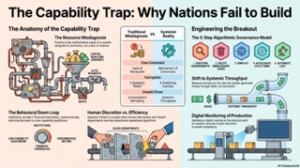
The highest-leverage intervention is the implementation of an algorithmic governance model. This removes human discretion. The state must execute five steps. First, question every requirement. Second, delete every possible step in a process. Third, simplify and optimize. Fourth, accelerate cycle time. Fifth, automate last.
To bypass the elite capture equilibrium, production-point digital monitoring must be mandated. This applies across incumbent sectors like sugar, cement, textiles, and real estate. This taxes output at the physical point of creation. It entirely removes the human discretion to evade compliance.
Simultaneously, executive accountability must be tied strictly to cycle times. Faster cycle times mean higher throughput with the same fixed resources. The speed at which a state can execute a function determines its capital velocity.
The chief executive must demand a weekly cadence. Every Tuesday, leadership must track the removal of specific bottlenecks. Accelerating cycle time can quickly break a faulty process. This exposes exactly what needs to be optimized.
A system of local optimums is a very inefficient system. The state must subordinate everything else to the exploitation of its primary constraints. Human behavior adjusts to the metric of evaluation. Change the measurement, remove the discretion, and the trap breaks.
CLOSING
Money is a result. Wealth is a result. State capacity is a result. We live in a world of cause and effect. A nation’s outward economic reality is simply a printout of its internal behavioral programming. When a system prioritizes the survival of incumbent networks over the accumulation of productive knowledge, stagnation is not an accident. It is the product of perfect execution. Nation building cannot be purchased. It must be engineered. The capability trap is absolute. A nation will only grow to the exact extent that its institutional blueprint allows.
About the Author