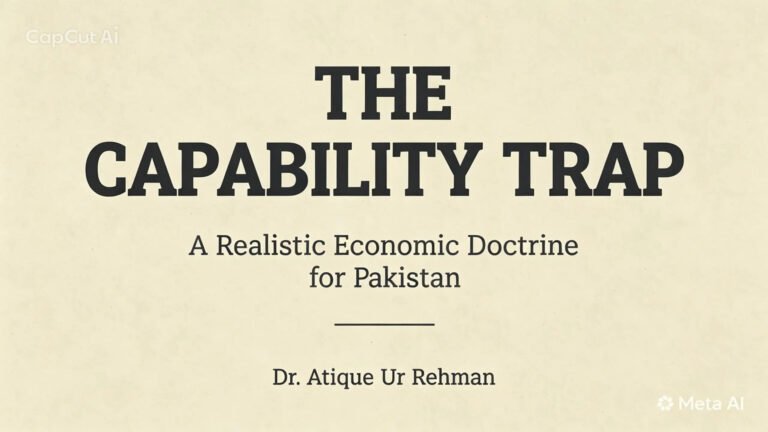
Pakistan has been ranked 136th out of 203 countries in the World Population Review’s 2026 Education Rankings, built on the World Top 20 (WT20) education database. The number will generate the usual cycle of outrage, op-eds, and ministerial silence. But the ranking itself is less interesting than what it reveals when placed next to our regional company — and what it conveniently leaves out.
The number that should actually embarrass us
It is not that Pakistan trails Denmark or Finland. It is that Pakistan trails Nepal (56th), Sri Lanka (61st), Kyrgyzstan (64th), and Tajikistan (87th) — four states with a fraction of our economy, our university infrastructure, and our claimed civilizational depth. Bangladesh, a country we still instinctively compare ourselves against from a position of assumed superiority, sits at 122nd — beating us by fourteen places. Even Afghanistan, a state that has spent the better part of two decades at war, is only ten places behind us at 146th.
This is the part of the story that gets buried under the global comparison. We do not need Denmark’s benchmark to be humiliated. We need Kathmandu’s.
A ranking with a hole in it
Read the data carefully and a second story emerges. The report draws on two separate methodologies — the U.S. News (USN) Best Countries score and the WT20 database. Pakistan has no listed USN score at all. That is not a footnote; it is a finding. The USN measure leans on international perception surveys and comparative institutional data — the kind that requires a country to be visible, studied, and engaged with by the global education-research apparatus. Pakistan’s absence from that dataset suggests we are not merely ranked low — we are, in significant part, not being measured at all. A country can improve a score. It cannot improve an absence. That requires being in the room where the data gets collected in the first place, which is itself a diplomatic and institutional failure layered on top of the education failure.
Why this keeps happening
The report attributes the gap between top and bottom performers to three factors: funding, literacy, and enrollment — concentrated most severely at the primary and secondary level. None of this is new to anyone who has looked honestly at Pakistan’s education budget as a share of GDP, provincial enrollment disparities, or the literacy gap between urban Punjab and rural Balochistan. What the ranking adds is comparative humiliation, not new information. We have known the diagnosis for decades. What we have never had is the political will to treat primary and secondary education as a security issue rather than a welfare line item.
The uncomfortable reframe
Pakistan spends heavily — relatively speaking — on maintaining external threat perception: border security, deterrence posture, strategic messaging. It spends comparatively little on the one input that determines whether the state has a functioning citizenry in thirty years. A country that cannot out-rank Nepal in education is not positioned to out-compete anyone in the domains that will define this century — AI, knowledge economies, soft power. Military deterrence buys time. It does not buy relevance. Only human capital does that, and on this measure we are being out-produced by neighbors we have spent seventy years treating as junior partners.
What should actually follow this ranking
Not another commission. Not another five-year plan that dies at the provincial handoff. The ranking should force two specific questions onto the table: why does Pakistan not appear in the USN dataset, and what would it take to close the enrollment and literacy gap with Nepal specifically — not Scandinavia — within a single election cycle. Smaller, humbler comparators are more useful than aspirational ones. Nepal is beatable. Denmark is not the point.
The number is 136th. The more urgent number is fourteen — the gap to Bangladesh. That is the one within reach.
About the Author