


The modern world has presented local businesses, institutions, and governments with a baffling paradox: the more money and effort they pour into social media and digital platforms, the more they seem to become targets for outrage and mockery. A new framework, detailed in Dr. Atique Ur Rehman’s 2026 book The Vacuum Economy, explains exactly why this is happening and offers a survival guide for local industries facing the dual threats of massive global corporations and a deeply divided economy.
At its core, this framework takes complex economic and technological problems and breaks them down into simplistic terms, providing a roadmap for local producers in developing economies across South Asia, Africa, and Southeast Asia.
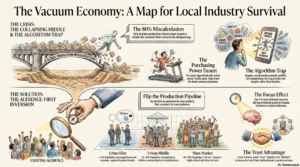
The Algorithm Trap
Most organizations assume that social media is a neutral public square where they can simply state their case and win over an audience. This is a fundamental misunderstanding. The internet’s algorithms are not designed to help institutions communicate; they are designed to maximize engagement, and the easiest way to generate engagement is through conflict.
When an institution posts organically, it runs straight into “confirmation bias”. People filter information through their existing beliefs. If they already disagree with a message, they reject it immediately and engage with hostility. This hostility is rewarded by the algorithm, spreading the negative reaction far wider than the original message.
Because of this, trying to persuade people through open, organic social media posts is effectively useless. The only way around this hostile environment is through paid advertising, which bypasses the public debate arena entirely and delivers a message directly to a consumer. Savvy operators understand this: they use the “Focus Effect,” planting a brand in a consumer’s mind using brief, three-to-five-second flashes during moments of high emotional distraction. By the time the consumer makes a choice, the brand is already deeply imprinted in their memory.
The Disappearing Middle Class
While the internet pushes people toward conflict, the global economy is splitting in two. For decades, the global market relied on a massive, thriving middle class. Today, due to relentless inflation and economic shocks, that middle class is seeing its purchasing power evaporate.
This is a civilizational crisis because approximately eighty percent of the world’s production infrastructure was built to serve this disappearing middle-tier consumer. What remains is a small, ultra-rich elite at the top, and a massive, stressed mass market at the bottom that can no longer afford standard middle-class goods.
When this middle tier collapses, it leaves behind a “vacuum”. The people in this vacuum still have needs, but they lack the supply of products at price points they can actually afford. They turn to cheaper substitutes, borrow money to maintain their lifestyle, or rely on informal street markets.
The Threat of Multinational Colonization
Logically, local industries should be the ones to fill this vacuum. A local manufacturer understands its community better than anyone, knows what local people can afford, and possesses a deep, generational trust that money cannot buy.
Yet, local industries are losing ground. They are being “colonized” by massive multinational corporations. This is not because the global giants have better products, but because they have an “exploitation gap” in digital capabilities. Multinationals use advanced data to monitor local markets, drop their prices temporarily to kill off local competition, build consumer habits using massive digital ad campaigns, and then raise their prices once the local businesses are gone.
The Golden Rule: Audience First
How can a local soap maker, food producer, or clothing brand fight back against global giants with unlimited budgets? Dr. Rehman proposes a massive shift in thinking, summarized in one simple rule: Do not find an audience for your product. Find a product for your audience.
For the last century, businesses invented a product and then spent millions trying to convince people to buy it. Today, that is a recipe for failure. Instead, businesses must look at the audiences that already exist. They must look at where people are gathering online and what they are emotional or even angry about. In the digital age, community controversy and outrage are actually signs of unmet needs.
Once a business understands what a community is lacking, it can build a product to perfectly fill that gap. When you build a product for an existing need, you do not have to fight for attention. The market is already waiting for you.
The Laboratory: Lessons from Pakistan
To understand how this works in the real world, The Vacuum Economy points to Pakistan, a country experiencing these extreme economic shifts at lightning speed.
In Pakistan, the mass market makes up roughly 65-70% of the population. To serve these consumers, local businesses must completely rethink how they sell. A family surviving on a tight daily budget cannot buy a large, expensive bottle of cooking oil; therefore, businesses must sell their products in small sachets scaled for daily or weekly buying.
Furthermore, these businesses must respect the deep cultural drivers of their communities. In South Asia, purchasing decisions are not made by individuals alone; they are driven by the biradari (community and kinship networks). Trust is paramount. Consumers also demand products that align with their faith, making Halal certification an absolute necessity. Finally, there is the concept of izzat (honor and dignity). Even if a product costs only a few pennies, it must be presented with quality and respect, allowing the consumer to maintain their dignity despite financial hardship.
Distribution is equally critical. Multinationals rely on massive supermarkets, but the real power lies in the informal economy—the kiryana (corner stores) and street vendors. Local businesses must treat these small store owners as vital partners.
The Digital Equalizer
The most uplifting revelation of this framework is that local businesses do not need millions of dollars to beat multinational corporations. Artificial Intelligence (AI) and basic digital tools are the great equalizers.
A local business does not need a massive marketing department. It simply needs to claim its free Google Business profile, set up a WhatsApp business channel to take orders directly from the community, and use YouTube or TikTok to share simple, honest videos.
Most importantly, local businesses have an unbeatable advantage: authenticity. A polished, million-dollar advertisement produced in a foreign country cannot compete with a video made by a local person, speaking the local language, understanding the exact cultural nuances of their neighbors. In today’s digital world, an authentic voice beats a massive budget every single time.
The Fight for Economic Sovereignty
Ultimately, the survival of local industry is about much more than just selling consumer goods. It is a battle for a nation’s “economic sovereignty”.
When a family buys a product made by a multinational corporation, the profit leaves the country to enrich global shareholders. But when that same family buys from a local producer, the money stays within the community. It pays local workers, supports local suppliers, and builds the country’s economic capability.
Local industry acts as the economic immune system of a community. By embracing the “Audience First” model, utilizing accessible digital tools, and honoring the dignity of the mass market consumer, local businesses can reclaim their rightful territory. The window of opportunity is wide open right now, and it is entirely up to local industries to step through it.