


Foreword
One Idea That Changes Everything
This book began as an observation — a simple, uncomfortable one. Governments, politicians, institutions, and businesses were pouring resources into social media, yet instead of winning audiences, they were becoming targets. The algorithm, it turned out, was not neutral. It had been built for engagement, and engagement feeds on conflict, not competence.
From that single observation, a framework emerged. Not through academic abstraction, but through the kind of thinking that happens when one idea is followed honestly to its conclusion, and then another idea is placed next to it, and then another.
The result is what you hold now: a complete framework for understanding how algorithmic forces, economic bifurcation, cultural dynamics, and the collapse of the middle tier market converge — and what that convergence means for local industry, particularly in the developing world.
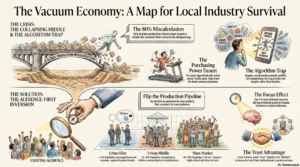
At its heart, this book proposes a single inversion:
Do not find an audience for your product. Find a product for your audience.
That one inversion — Audience First Production — changes everything downstream. It changes how products are designed, how brands are built, how campaigns are structured, and ultimately how local industry can survive and thrive in the face of multinational colonization of the very markets it naturally owns.
This framework is dedicated to the local producer, the small manufacturer, the community-rooted entrepreneur in South Asia, Africa, and Southeast Asia — who has every natural advantage and lacks only the structure and strategy to use it.
The window is open. This book is the map.
Dr Atique Ur Rehman
PART ONE
THE CRISIS
Understanding the forces that are breaking existing models of communication, production, and market strategy.
CHAPTER 1
The Algorithm Trap
Why institutions fail on social media — and what actually works
Every government department, political party, corporation, and institution eventually arrives at the same conclusion: they need a social media presence. They hire teams, produce content, build followings, and invest budgets. And then, almost without exception, they become targets.
The posts meant to build reputation attract criticism. The statements designed to project strength invite mockery. The carefully crafted narratives encounter confirmation bias — the audience that was supposed to be persuaded was never open to persuasion in the first place. The algorithm was not built to help institutions communicate. It was built to maximize engagement. And engagement feeds on conflict.
Confirmation Bias and the Blocked Path
Confirmation bias is not a flaw in human psychology — it is a feature. People do not process information neutrally. They filter it through existing beliefs, and messages that challenge those beliefs are rejected before evaluation begins. An institution trying to change minds through organic social media content is not just fighting indifference. It is fighting a cognitive architecture that actively resists unwanted messages.
This is why debate and open-source content largely fail as institutional communication strategies. The people who would be persuaded are already persuaded. The people who would not be persuaded engage instead with hostility — and that hostility generates more algorithmic reach than the original message ever achieved.
The Advertising Exception
There is one format that escapes this trap. Paid advertising does not enter the social feed as a debate participant. It arrives as a sponsored placement, algorithmically delivered, not subject to the same critical engagement dynamics. It does not invite a reply thread. It makes its impression and departs.
This is structural, not incidental. Organic posts compete in the arena of public opinion, where critics have equal reach. Advertisements operate in a parallel channel where the message is delivered without the crowd. The algorithm for paid content is bought. It does not come in the form of a post.
Debate and open-source content are useless in a hostile algorithm. Only advertising campaigns succeed — because their algorithm is purchased, not earned.
The Controversy Engine
Once the advertising advantage is understood, a deeper mechanic becomes visible. Controversy generates organic engagement. Organic engagement trends. Trending content attracts advertising attention. And paid amplification riding a trending wave achieves reach at dramatically lower cost than a cold campaign.
The sophisticated operator therefore does not simply advertise. They engineer controversy first, then amplify it with paid placement. The controversy is the fuel. The advertisement is the vehicle that rides the flame. This is not a secret. It is the operating logic of modern political and commercial communication — finally made legible.
The Focus Effect
In the film Focus, Will Smith’s character plants a number in the mind of a target — not through argument or persuasion, but through environmental imprinting during a moment of peak emotional distraction. The target believes he is making a free, independent choice. The choice was prepared for him, invisibly, while his attention was elsewhere.
This is the behavioral model of effective modern advertising. Not the thirty-second commercial. Not the full-page feature. The three-to-five second brand imprint, delivered during high emotional engagement, that bypasses rational filtering entirely and lodges in memory as association rather than argument.
The target thinks they are choosing freely. The brand was planted before the choice was made. That is the Focus Effect.
A full advertisement triggers the rational brain’s defense mechanism. It is recognized as persuasion and evaluated skeptically. But a three-to-five second logo flash during an emotional peak does not trigger evaluation. It imprints. And imprints are remarkably durable.
Audience First Production: The Inversion
The conventional production logic runs: develop a product, identify the audience, build the campaign. This logic has governed marketing for a century. In the algorithmic age, it is increasingly broken.
The inversion is simple but total. Do not begin with the product. Begin with the audience. Find where engagement already exists. Understand the emotional energy driving it. Identify the unmet needs embedded in that energy. Then build the product, message, or campaign to serve what is already there.
When production follows audience, the market is pre-warmed. The conversation already exists. The brand does not need to create demand — it needs only to arrive at the demand already flowing. This is not just a marketing insight. It is a production philosophy. It is the foundation on which the rest of this framework is built.
CHAPTER 2
The Bifurcating World
The disappearing middle and what it means for every market on earth
The global economy is splitting. At one end, an elite market — small, resilient, insulated from macro shocks by accumulated wealth. At the other, a mass market — vast, stressed, and increasingly unable to access goods designed for a middle class that is disappearing. Between them, the middle tier — which built the twentieth century’s consumer economy — is collapsing.
Inflation and the Liquidation of Purchasing Power
Inflation is not, in 2025, a temporary disruption. It is a structural condition. The purchasing power of the global middle class has been eroding for over a decade, accelerated by pandemic-era monetary expansion, supply chain fragility, energy price volatility, and currency depreciation in developing economies. The consumer who could afford a middle-tier product in 2015 is making different calculations today — responding rationally to the reality that their money buys less and the buffer between sufficiency and stress has narrowed or disappeared.
The Three-Tier Collapse
Consider the market structure governing global consumer goods for the past fifty years. At the top, premium products serving a small, high-margin segment. In the middle, branded consumer goods at accessible prices, serving the aspirational middle class. At the bottom, commodity products serving the price-sensitive mass market.
The middle tier — representing approximately eighty percent of global production infrastructure — was built to serve a middle class contracting in real terms across virtually every major economy. The elite market will continue to thrive. The commodity market will survive. But the middle tier, caught between luxury consolidation above and commodity pressure below, faces structural collapse.
Eighty percent of global production infrastructure is aimed at a customer who is disappearing. That is not a market problem. It is a civilizational miscalculation.
The Vacuum
What disappears when the middle tier collapses is not simply a market segment — it is a social infrastructure. When that tier collapses, it leaves a vacuum. Not a vacuum of need — needs remain, and intensify. A vacuum of supply. History provides consistent answers about what fills such vacuums: substitution products emerge; debt-funded consumption extends the illusion of middle-class participation; the informal economy expands; identity consumption intensifies. And local industry, which understands the community it serves and can price to actual purchasing power, steps into the breach.
CHAPTER 3
The Echo Chamber Economy
Why the algorithm is loud but commercially hollow
The algorithm is a machine optimized for engagement, and engagement is maximized by content that provokes strong emotional responses. Outrage, fear, tribal solidarity, moral certainty — these are the fuels on which the engagement economy runs. The result is an internet that feels intensely alive with conflict and opinion — and that is, in purchasing terms, largely hollow.
The Purchasing Power Desert
The most algorithmically active users of social media are, in most markets, not the most commercially powerful. They are engaged, vocal, and highly visible — but their engagement is driven by the very conditions that constrain their purchasing power: economic stress, political frustration, social anxiety.
Those with genuine purchasing power are conspicuously absent from algorithmic social media. They have neither the time nor the inclination for engagement-maximizing content. They are algorithmically invisible. But commercially decisive.
The people with purchasing power are not in the algorithm. The algorithm is full of people without money. Strategy built on algorithmic visibility will miss the actual market.
Voter Turnout as Evidence
The disengagement of capable citizens from public discourse manifests politically with remarkable consistency. Voter turnout across developed and developing democracies rarely exceeds fifty percent. The citizens most engaged in algorithmic political debate frequently are not the citizens who show up to vote. This is not apathy — it is a rational withdrawal from a discourse colonized by algorithmic incentives that reward extremity over nuance, conflict over resolution, performance over substance.
The Commercial Implication
The audience you can see is not the audience that matters most. Before any campaign is built, the critical question must be answered: does this audience have the purchasing power to act on what we are offering? And if not, where is the audience that does? Audience-product fit is not merely a demographic exercise. It is a purchasing power analysis.
PART TWO
THE OPPORTUNITY
Identifying the vacuum, understanding the exploitation gap, and building the case for Win-Win as the only durable strategy.
CHAPTER 4
The Vacuum
What the disappearing middle leaves behind — and who naturally fills it
Every structural collapse creates a commercial opportunity. The disappearance of the middle tier leaves a community of consumers with enduring needs and no adequate product to meet them at the price point they can afford. That community does not simply stop consuming. It finds alternatives, improvises, and creates the demand signal that defines the next commercial opportunity.
The Four Vacuum Fillers
Historical analysis of economic contractions — the Great Depression, the 2008 financial crisis, the COVID supply chain disruptions — reveals four consistent mechanisms through which market vacuums are filled. First, substitution: consumers find alternatives at accessible price points, and the consumer who discovers a substitute is adequate rarely returns to the original. Second, debt illusion: middle-class consumption maintained through credit even as real purchasing power declines — the most dangerous filler, because when the debt cycle breaks, the collapse is sudden. Third, informal economy expansion: street markets, grey markets, and community-based distribution step into the breach. Fourth, identity consumption: dignity and social signaling maintained even within severely constrained budgets.
Local Industry as Natural Vacuum Owner
Across all four mechanisms, one type of producer holds structural advantage: the locally rooted industry that understands the community it serves, prices to actual purchasing power, distributes through trusted informal channels, and carries the cultural credibility that no outside brand can purchase.
Local industry does not need to win this market. It already owns it. The question is whether it will keep it — or watch it colonized by those with better tools.
CHAPTER 5
The Exploitation Gap
How multinationals colonize territory they do not culturally own
If local industry naturally owns the vacuum, why is it losing ground? The answer is not product quality, price, or consumer preference. It is a structural asymmetry in capability — specifically, in digital capability and strategic organization.
The Asymmetry
Local industry holds powerful natural advantages: community trust built over years, cultural understanding of local preferences, price flexibility reflecting actual cost structures, and distribution relationships embedded in informal networks. Multinational corporations hold a different set: capital, organizational structure, digital sophistication, data analytics capability, AI-driven marketing tools, and budgets to sustain multichannel campaigns simultaneously.
In a pre-digital world, local advantages were sufficient. In a digital world, where purchasing decisions are increasingly influenced by digital presence and algorithmic visibility, the multinationals’ advantages have become decisive.
The Colonization Playbook
The sequence is recognizable: market data gathered through digital channels local industry is not monitoring; a product positioned at a competitive, subsidized price point to establish initial share; digital campaigns building brand familiarity before local industry recognizes the threat; prices normalized upward once consumer habits are formed; local industry, having lost share during the subsidized entry phase and lacking resources to rebuild, contracts or exits. This is not conspiracy. It is standard competitive strategy executed with superior tools.
The Unrecognized Asset
Local industry consistently undervalues its most powerful asset: trust built over generations within a specific community. In consumer goods categories — food, household products, personal care — trust is not a soft value. It is the primary purchase driver. Consumers do not experiment with cooking oil. They buy what they know. That trust cannot be purchased by any multinational with any advertising budget. It must be earned over time. Local industry already has it.
CHAPTER 6
The Win-Win Imperative
Why positive-sum strategy is not idealism — it is optimal
Across every major framework for understanding human cooperation and competition — game theory, organizational psychology, geopolitical theory, development economics — one finding recurs: positive-sum strategies in which all parties gain consistently outperform zero-sum extraction over time. This is not a moral claim. It is an empirical one.
The Evidence Across Frameworks
Game theory demonstrates that in repeated interactions — which describe virtually all real commercial relationships — cooperative strategies outperform defection. Covey’s framework of interdependence translates directly: the brand that extracts maximum margin in the short term loses community trust and faces long-term rebuilding costs. The brand that consistently delivers genuine value builds loyalty that compounds.
Deterrence theory shows that the most stable competitive equilibria are those in which all parties have sufficient capability to impose costs on aggression. Local industry with genuine digital capability is far more resistant to multinational colonization than defenseless local industry. Capability deters aggression. And Acemoglu and Robinson’s analysis in Why Nations Fail demonstrates that extractive institutions consistently produce stagnation, while inclusive institutions produce sustained growth.
Win-Win is not a soft ideal. It is the only strategy that survives the long game. Every other strategy eventually destroys the conditions it depends on.
The consultancy model in Part Four is built explicitly on Win-Win principles. Local industry gains digital capability. The community retains economic value. Consumers gain better products at accessible prices. The national economy retains commercial sovereignty. Every party gains concrete, measurable value. The framework is commercially viable precisely because it is genuinely beneficial.
PART THREE
THE FRAMEWORK
The theoretical and practical architecture of Audience-First Production, behavioral imprinting, and the cultural dimensions of Pakistan.
CHAPTER 7
Audience First Production
The inversion that changes everything downstream
The conventional production pipeline runs in a single direction: from idea to product to market to audience. The failure rate of this model is well documented. Most new products fail within two years. Most marketing campaigns generate awareness without conversion. Most brand launches do not achieve sustained market share. These are not failures of execution. They are failures of sequence.
The Inverted Pipeline
Audience First Production reverses the sequence entirely. Instead of beginning with a product and finding an audience, it begins with an audience — an existing community of engaged, emotionally invested, identifiable people — and asks what product, message, or offering would genuinely serve the needs already active in that community.
The audience already exists. The emotional energy already exists. The conversation is already happening. The demand signal is already present. The producer does not create any of these things. They identify and serve what is already there. The market is pre-warmed. The brand enters a conversation that exists rather than trying to start one.
Andrew Tate did not build a product and find an audience for it. He found a controversially engaged male audience — and then built products, identity, and community specifically for that existing energy. Product followed audience. Not the other way around.
Controversy as a Demand Detector
In the algorithmic environment, controversy is not merely a communication phenomenon. It is a demand signal. When a community is highly engaged around a specific controversy — economic grievance, cultural anxiety, social frustration — that engagement reveals an unmet need. Something is absent, broken, or failing. The Audience First producer reads controversy not as noise to be avoided but as intelligence to be decoded: what is this community actually asking for, beneath the emotional surface of what it is angry about?
The Matching Layer: Audience-Product Fit
Raw engagement is not sufficient for production decisions. Engagement without purchasing power is commercially irrelevant. The critical analytical step is matching audience characteristics — demographics, psychographics, economic capacity, cultural context — to product requirements. The correct question is always: which engaged audience has the purchasing power and behavioral readiness to act on what we are offering? Finding this match is the core analytical work of Audience First Production.
CHAPTER 8
Cultural & Behavioral Dimensions
Pakistan — the framework made visible
Pakistan is not merely an example within this framework — it is the framework made visible. Every structural force described in the preceding chapters converges on Pakistan simultaneously, with an intensity that makes it one of the most instructive economic laboratories in the developing world today. The country is experiencing a compressed bifurcation — a process that took decades in Western economies is happening here within a single generation.
Pakistan does not need to study this framework. Pakistan IS this framework — lived, urgent, and unforgiving.
The Three Worlds of Pakistani Society
World One — The Urban Elite (3–5% of population)
Concentrated in Defence Housing Authorities, Gulberg, Clifton, and the F-series sectors of Islamabad, this segment’s consumption patterns are almost entirely decoupled from local economic conditions. They price in dollars, travel internationally, and access global brands through imports or premium local proxies. This segment is already captured by multinational strategy and is not the primary focus of this framework.
World Two — The Urban and Semi-Urban Middle (25–30% of population)
Located across Karachi, Lahore, Faisalabad, Multan, Peshawar, and their satellite towns, this segment built its identity on aspiration. Inflation has devastated it not just financially but psychologically — they experience status anxiety: the gap between who they believed they were becoming and what economic reality is forcing them to accept. Products that allow this segment to maintain self-respect at adjusted price points will win deep, durable loyalty.
World Three — The Mass Market (65–70% of population)
Rural communities, peri-urban settlements, labor-class urban neighborhoods, and the vast informal economy constitute Pakistan’s true mass market. Their purchasing decisions are highly rational within severe constraints, prioritizing utility, trust, familiarity, and community endorsement. This segment represents the actual vacuum — and local consumer goods industry that understands it owns the most defensible commercial territory in Pakistan.
Cultural Architecture: What Drives Pakistani Consumer Behavior
The Biradari System and Trust Networks
Pakistan’s social fabric is organized around biradari — extended kinship and community networks that function as the primary unit of trust and decision-making. A purchasing decision is rarely fully individual. What the biradari uses, recommends, or endorses carries decisive weight. A product that achieves biradari endorsement spreads organically through trust networks that no advertising budget can buy. Community penetration, not mass reach, is the correct metric.
Religious and Halal Consciousness
Religious identity is a constant and active filter in Pakistani consumer behavior. Halal certification, Islamic financing compliance, and alignment with religious values are baseline requirements across all segments. A local consumer goods brand that authentically embeds Islamic values into its identity gains a trust layer that foreign competitors struggle to match — particularly in food, personal care, and household cleaning categories.
The Honor Economy
Pakistani culture operates substantially on the basis of izzat — honor, dignity, and face. Purchasing decisions carry social signaling weight even at low price points. Value propositions must address both utility and dignity simultaneously. The consumer buying a one-rupee sachet of shampoo is not buying a cheap product — they are accessing quality within a budget constraint. The brand that honors this earns loyalty that is extraordinary in its durability.
Fatalism and Agency — The Dual Psychology
Pakistani society holds in tension two powerful orientations: fatalism, rooted in religious acceptance, and fierce agency, rooted in survival instinct. Messaging that combines reassurance with empowerment outperforms purely aspirational advertising. Tell the consumer this product understands their reality — then show how it improves it. Do not sell a fantasy. Sell a better version of the life they are actually living.
Working Behaviors: How Pakistanis Live and Buy
The Informal Economy as Primary Infrastructure
Pakistan’s informal economy is the primary commercial infrastructure for the majority of the population. Street markets, kiryana stores, rehri vendors, and community-based distribution networks move more consumer goods than organized retail in most cities outside the top tier. Last-mile distribution through informal channels is not a compromise — it is the correct strategy.
The Mobile-First Reality
Pakistan has crossed 190 million mobile connections with smartphone penetration accelerating rapidly. For vast segments, the mobile phone is the primary screen, entertainment platform, and commerce gateway. YouTube, TikTok, and WhatsApp dominate media consumption. A local consumer goods company with no presence on these platforms is invisible to its most natural audience.
The Female Decision-Maker
Across all socioeconomic segments, the female head of household is the primary decision-maker for consumer goods, food, personal care, and household products. Brands that genuinely understand, respect, and speak authentically to Pakistani women as capable decision-makers will build loyalty that is both deep and multigenerational. This is not social commentary — it is commercial strategy.
Seasonal and Religious Purchasing Cycles
Pakistani consumer behavior is profoundly shaped by Ramadan, Eid ul-Fitr, Eid ul-Adha, wedding seasons, harvest cycles, and back-to-school periods. These create dramatic, predictable purchasing spikes. Local industry must build an annual demand calendar anticipating these cycles six months ahead and aligning production, inventory, and marketing resources accordingly.
The Needs Hierarchy: What Pakistanis Actually Need Right Now
Inflation has pushed basic physiological needs back into active concern for segments that had resolved them a decade ago. Safety needs are elevated by chronic instability — brands communicating reliability tap a deep psychological need. Belonging needs are primary drivers even under economic stress; consumer goods enabling social participation carry emotional significance that functional marketing cannot reach. And esteem needs are active across all segments — quality signaling must be credible even at the lowest price points.
The Five Actionable Imperatives for Pakistani Local Industry
IMPERATIVE 1 — Restructure for the Buying Increment
1.1. Sachet and Unit Redesign
Redesign product architecture around daily and weekly buying increments. A household managing on Rs. 1,000 per day cannot buy a Rs. 800 bottle of cooking oil. They can buy Rs. 80 worth daily. The product must meet them where they are.
1.2. Kiryana Channel Investment
Treat kiryana store owners as strategic partners, not distribution endpoints. They are community trust nodes. Invest in relationships, provide credit flexibility, and create kiryana-specific pack sizes and pricing.
1.3. Rural Packaging Localization
Packaging in Urdu, with locally resonant imagery and messaging, is a basic requirement for the 65% market that multinationals consistently fail to serve authentically.
IMPERATIVE 2 — Build Digital Presence on the Right Platforms
2.1. YouTube First Strategy
YouTube is Pakistan’s mass media. Simple, authentic, locally produced content — cooking demonstrations, product usage, community stories — outperforms expensive production because it feels real.
2.2. WhatsApp Commerce Infrastructure
Build WhatsApp business channels, enable ordering through WhatsApp, and use it for community-level promotions through trusted local networks.
2.3. TikTok for Youth Entry Points
Urban youth influence household purchasing in specific categories. TikTok presence in food, personal care, and household innovation builds brand awareness in the pipeline generation.
IMPERATIVE 3 — Apply the Focus Effect Locally
3.1. 3–5 Second Brand Imprinting
Identify high-engagement local YouTube channels and community content creators whose audiences match the target consumer profile. Place 3–5 second brand imprints during peak emotional moments — not full advertisements.
3.2. Community Controversy Awareness
Monitor community-level concerns and position brand messaging to enter those conversations authentically — as a local brand that listens and responds.
3.3. Biradari Seeding
Identify community influencers within biradari networks and design product seeding programs that work through trust networks rather than around them.
IMPERATIVE 4 — Lead with Dignity, Not Aspiration
4.1. Honest Value Communication
In an environment of extreme economic stress, aspirational advertising showing disconnected lifestyles generates resentment, not desire. Lead with honest value: this product is good, fairly priced, and understands your life.
4.2. Quality Signaling at Every Price Point
Invest in packaging quality, product consistency, and ingredient clarity even at the lowest price points. Dignity is not a luxury feature — it is the baseline for durable brand loyalty.
4.3. Ramadan and Eid Campaigns Built Around Community
Design seasonal campaigns around community participation and family connection. The emotional register of belonging consistently outperforms the register of acquisition in Pakistani cultural context.
IMPERATIVE 5 — Formalize to Compete
5.1. Basic Digital Structure
Register Google Business profile, establish consistent social media handles, create a simple product information website. These basic steps immediately increase competitive positioning against multinational digital presence.
5.2. Data Collection from Day One
Begin collecting data on purchasing patterns, geographic distribution, and seasonal demand cycles. This does not require sophisticated technology — it requires consistent recording.
5.3. Halal and Quality Certification
Pursue PSQCA and Halal certification as competitive assets rather than regulatory compliance. Certification signals credibility in an environment of widespread consumer distrust.
The Political Instability Variable: Turning Uncertainty into Advantage
Pakistan’s chronic political instability is typically analyzed as a pure negative for business. This analysis is incomplete. Supply chain disruptions that devastate multinational distribution open market share windows for local alternatives. Currency crises that make imported raw materials prohibitively expensive favor locally sourced substitution. Policy uncertainty that discourages foreign investment creates breathing room for local capacity building.
The instability that Pakistan suffers is also, paradoxically, the protection that local industry has not yet learned to leverage.
PART FOUR
THE CONSULTANCY MODEL
A practical, commercially viable five-phase model for deploying this framework with local industry across South Asia, Africa, and Southeast Asia.
CHAPTER 9
The Digital Equalizer
Why AI and digital tools are not the enemy — they are the weapon local industry has not yet picked up
There is a temptation, when analyzing the damage that algorithmic forces have done to local industry, to conclude that digital capability is inherently hostile to community-level commerce. This conclusion is wrong, and acting on it is fatal.
Digital tools are not inherently the property of multinationals. They are infrastructure — like roads or electricity — that confers advantage on whoever uses them effectively. The multinational has used them effectively. Local industry has not. That is the gap. And gaps can be closed.
What Digital Tools Actually Require
The most common misconception about digital marketing capability is that it requires large budgets and sophisticated technical teams. The fundamental capabilities that would transform local industry’s competitive position are accessible, affordable, and learnable. A consistent social media presence requires a smartphone and someone who understands the community being served. A YouTube channel requires the same, plus willingness to produce authentic content. A WhatsApp business account requires nothing beyond a phone number. Google Business registration is free.
None of these capabilities are beyond the reach of a Pakistani kiryana supplier, a Bangladeshi textile producer, or a Kenyan household goods manufacturer. What they require is not resources — it is framework. A structured understanding of what to do, in what sequence, for what purpose.
AI as the Great Equalizer
Artificial intelligence is increasingly accessible to small and medium enterprises through tools requiring no technical expertise and minimal cost. AI-assisted content creation allows a local producer to generate consistent, culturally relevant social media content without a dedicated marketing department. AI-powered analytics can surface purchasing patterns from basic sales data. AI translation tools can produce Urdu, Bengali, Swahili, or Tagalog content from English briefs in seconds.
The democratization of AI capability is, for local industry in developing economies, potentially the most significant commercial opportunity of the decade. The question is whether local industry will recognize and capture it before the window closes.
The Authenticity Advantage
There is one digital capability that no multinational can replicate: authentic community voice. Content created by someone who genuinely belongs to the community they are addressing, who speaks the language as a native, who references the cultural details that only an insider knows — this carries credibility that polished multinational production cannot match.
The multinational has the budget. Local industry has the voice. In the algorithmic age, authentic voice — properly distributed — beats budget. Every time.
CHAPTER 10
The Five-Phase Consultancy Model
From diagnosis to scale — a complete operational framework
The theoretical framework developed across the preceding chapters is only as valuable as its practical implementation. This chapter presents the operational model through which the framework is deployed — a structured, five-phase consultancy engagement designed for local consumer goods industry in developing economies, producing clients that internalize the capability to sustain and grow their competitive position independently.
PHASE 1 — DIAGNOSE
The diagnostic phase establishes the complete picture of the client’s position: natural advantages, structural vulnerabilities, digital footprint, distribution reach, community trust assets, and specific competitive threats from multinational activity. It also maps the audience landscape — identifying which community segments represent genuine purchasing power, their behavioral and cultural characteristics, and where the match between audience energy and client offering is strongest.
Deliverable: Full diagnostic report with competitive landscape, audience map, and priority opportunity identification.
PHASE 2 — MAP
The mapping phase translates diagnostic findings into a strategic framework specific to the client’s context. Audience First Production principles are applied: the target audience is defined by purchasing power analysis, behavioral mapping, and cultural fit assessment. The gap between what the client currently offers and what the target audience most needs is identified and quantified. The mapping phase also identifies specific digital channels, community influencers, informal distribution networks, and seasonal windows representing the highest-value deployment opportunities.
Deliverable: Strategic map with audience-product fit analysis, channel prioritization, and resource allocation framework.
PHASE 3 — STRUCTURE
The structure phase builds the organizational and digital infrastructure that local industry currently lacks: consistent digital presence across priority platforms, basic data collection systems, brand identity authentically reflecting community values, distribution documentation making informal channel relationships visible and manageable, and quality and Halal certifications providing competitive credibility. The goal is the minimum viable structure enabling competitive effectiveness — not multinational-scale infrastructure that exceeds the client’s capacity to sustain it.
Deliverable: Digital presence architecture, data collection system, brand identity guidelines, and distribution documentation.
PHASE 4 — IMPRINT
The imprint phase deploys the Focus Effect framework for the client’s specific audience and context. High-engagement community content creators whose audiences match the target consumer profile are identified and engaged for 3–5 second brand imprinting placements. Seasonal campaigns aligned with Ramadan, Eid, and other high-engagement cultural moments are designed and executed. Community seeding through biradari and trust networks is structured and activated.
Deliverable: Imprint campaign calendar, community creator partnerships, and seasonal activation plan.
PHASE 5 — SCALE
The scale phase builds the client’s capacity to sustain and expand their competitive position independently. Training programs transfer digital marketing capability to internal teams. Systems are documented so that what was built by the consultancy can be operated and evolved by the client. Distribution relationships are formalized to support geographic expansion. And Win-Win ecosystem opportunities — partnerships with other local producers, community investment programs, supply chain collaboration — strengthen the client’s position while generating goodwill that no advertising can replicate.
Deliverable: Capability transfer program, operations documentation, expansion roadmap, and ecosystem partnership framework.
Revenue and Delivery Architecture
Tier 1. Diagnostic Audit — One-Time Engagement
A complete diagnostic and strategic map delivered as a standalone engagement, appropriate for clients wanting to understand their position before committing to a full transformation program.
Tier 2. Structured Transformation — Monthly Retainer
Phases 1 through 3 delivered over a three-to-six month engagement, building the digital and organizational infrastructure that enables competitive effectiveness.
Tier 3. Campaign Management — Performance-Based
Phase 4 delivered on an ongoing basis, with fees linked to measurable outcomes — reach, engagement, distribution expansion, sales growth. Aligns consultancy incentives with client success.
Tier 4. Training and Capacity Building — Workshop Model
Phase 5 delivered as structured training programs for internal teams, enabling the client to self-sustain and evolve their capability beyond the consultancy engagement.
Geographic Deployment
In South Asia — Pakistan, Bangladesh, India — the primary dynamics are the biradari trust structure, mobile-first digital environment, Halal consciousness, informal distribution infrastructure, and Islamic and Hindu cultural calendar purchasing rhythms. In Sub-Saharan Africa, the mobile money ecosystem, extraordinary linguistic diversity requiring hyper-local content, community trust structures anchored in tribal and religious networks, and the rapidly expanding youth demographic define the landscape. In Southeast Asia — Indonesia, the Philippines, Vietnam, Thailand — high social media penetration, established e-commerce infrastructure, strong local brand loyalty in food and personal care, and the cultural dimensions of community face shape the operating environment. In all three geographies, the core framework applies: identify the audience first, match product to genuine need, imprint during peak emotional engagement, and build digital structure that enables local industry to compete effectively.
PART FIVE
THE VISION
Economic sovereignty, the one-idea principle, and why this framework matters beyond commerce.
CHAPTER 11
Economic Sovereignty
Local industry as the front line of a larger battle
This book has been written as a business framework. But the forces it addresses are not merely commercial. They are civilizational.
When multinational corporations colonize the consumer goods markets of developing economies — when the cooking oil, soap, flour, and personal care products purchased by families of Pakistan, Nigeria, or Indonesia are produced by corporations headquartered in Europe or North America, optimized for global shareholder returns — something is lost that is very difficult to rebuild.
What is lost is not just market share. It is the circulation of value within a community. When a Pakistani family buys from a Pakistani producer, the margin stays in Pakistan — paying Pakistani wages, funding Pakistani suppliers, generating Pakistani tax revenue, building Pakistani capability. When the same family buys from a multinational, the margin leaves.
Local industry is not just a commercial category. It is the economic immune system of a community. When it weakens, the community becomes dependent on forces it cannot control and vulnerable to extraction it cannot resist.
Strengthening local industry is therefore not merely a business strategy. It is an act of economic sovereignty. And in an era when the tools of digital capability are becoming genuinely accessible — when AI, social media, and mobile commerce are available to the small producer as well as the global corporation — the opportunity to build that sovereignty is real and present.
The window is open. It will not stay open indefinitely. Multinationals are learning to navigate cultural complexity, produce authentic-seeming local content, and distribute through informal channels in ways that were not possible a decade ago. The advantage of local industry is genuine but not permanent. It must be built into competitive capability before the gap closes.
CHAPTER 12
The One Idea
How a single inversion becomes a complete theory of competitive advantage
This book began with a crisis. Institutions failing on social media. Algorithms rewarding conflict. Middle markets collapsing. Multinationals colonizing the vacuum. The outlook for local industry in developing economies, surveyed from a distance, appears bleak.
But the book did not stay with the crisis. It followed one idea.
Do not find an audience for your product. Find a product for your audience.
That single inversion produces an entirely different commercial logic. It eliminates the cost and risk of building awareness from scratch. It grounds product development in verified community need. It positions brands as servants of existing desire rather than creators of artificial demand. It transforms controversy from a threat into intelligence. It makes the algorithm a research tool rather than an enemy.
And when applied to the specific context of local industry in developing economies — where community trust is already banked, cultural intelligence is already present, and distribution relationships are already embedded — the inversion becomes a framework for economic resilience and sovereignty that no multinational can replicate.
Ford did not invent the car. He inverted who could own one. Jobs did not invent the phone. He inverted what it was for. Netflix did not invent movies. They inverted how you access them.
The Vacuum Economy does not invent local industry. It inverts the pipeline through which local industry reaches its market. In that inversion, it recovers the competitive advantage that local industry already possesses but has not known how to use.
That is enough. That is everything.
Conclusion
A call to action
The framework is complete. The opportunity is real. The window is open.
For local industry leaders across South Asia, Africa, and Southeast Asia: do not wait for the environment to stabilize. It will not stabilize on a convenient schedule. Start with the audience. Understand the community you already serve. Map its purchasing power, cultural architecture, and behavioral rhythms. Find the match between your product and its genuine needs. Build the minimum digital structure that makes you visible to the community that already trusts you. Begin imprinting — consistently, authentically, in the cultural language of your community.
For policymakers: investment in digital literacy programs, in consultancy capacity for small and medium enterprises, in certification infrastructure, and in data collection systems that give local producers visibility into their own markets — these are not charitable interventions. They are investments in the economic sovereignty of the communities you are elected to serve.
For investors: the elite market is small, saturated, and contested by well-capitalized global players. The mass market — the vacuum left by the collapsing middle tier — is vast, underserved, and accessible to operators with the cultural intelligence and community trust that cannot be purchased at any price.
The most defensible commercial territory in the developing world is not in the gleaming malls of elite urban districts. It is in the kiryana stores, the community markets, the WhatsApp groups of the mass consumer — served by local industry that understands, respects, and belongs to the community it feeds.
This is the Vacuum Economy. This is where the opportunity lives. This is what this book was written to make visible.
One idea. One inversion. One window. It is open now.
Dr Atique Ur Rehman
2025
Appendix A: Framework Glossary
Key terms and concepts
Audience First Production
The principle of identifying and understanding an engaged audience before designing a product or campaign, inverting the conventional production pipeline.
Biradari
Extended kinship and community networks in South Asian societies that function as the primary unit of trust, reputation, and collective decision-making.
Confirmation Bias
The cognitive tendency to filter incoming information through existing beliefs, rejecting messages that challenge those beliefs before evaluation begins.
Echo Chamber Economy
The commercial reality produced by algorithmic social media, in which highly engaged audiences are concentrated in controversy-driven communities with limited purchasing power.
The Focus Effect
The behavioral advertising model in which brand imprinting during moments of peak emotional engagement produces subconscious brand association that bypasses rational ad-filtering defenses.
Izzat
The Pakistani and broader South Asian cultural concept of honor, dignity, and face that shapes social behavior and consumer decision-making across all economic segments.
Kiryana Store
The community-level general store that serves as the primary retail infrastructure for consumer goods in Pakistani and broader South Asian informal economies.
Middle Tier Collapse
The structural contraction of the consumer goods market segment serving aspirational middle-class consumers, driven by inflation, purchasing power erosion, and wealth bifurcation.
Multinational Colonization
The process by which globally capitalized corporations capture local consumer goods markets through superior digital capability, subsidized market entry pricing, and algorithmic brand building.
The Vacuum
The commercial space left by the collapse of the middle tier consumer goods market, representing vast unmet need accessible to local industry with the right strategy and capability.
Win-Win Strategy
Positive-sum commercial approaches in which all parties — producer, consumer, community, economy — gain genuine value, producing durable competitive advantage over zero-sum extraction.
— End of The Vacuum Economy —
Dr Atique Ur Rehman | 2026
(atiquesheikh2000@gmail.com)