{"source_type":"vicut","data":{"source_type":"vicut","pictureId":"6AA9EA63-3A4C-48D6-8F44-4698917580A4","product":"vicut","source_platform":"mobile_1","client_key":"aw889s25wozf8s7e","enterFrom":"new_image","capability_name":"capcut_photo_editor,ai_photo_editor","appVersion":"18.0.0","region":"PK","editType":"image_edit","os":"ios"},"tiktok_developers_3p_anchor_params":"{"region":"PK","product":"vicut","client_key":"aw889s25wozf8s7e","capability_name":"capcut_photo_editor,ai_photo_editor","pictureId":"6AA9EA63-3A4C-48D6-8F44-4698917580A4","os":"ios","source_type":"vicut","source_platform":"mobile_1","appVersion":"18.0.0","enterFrom":"new_image","editType":"image_edit"}"}
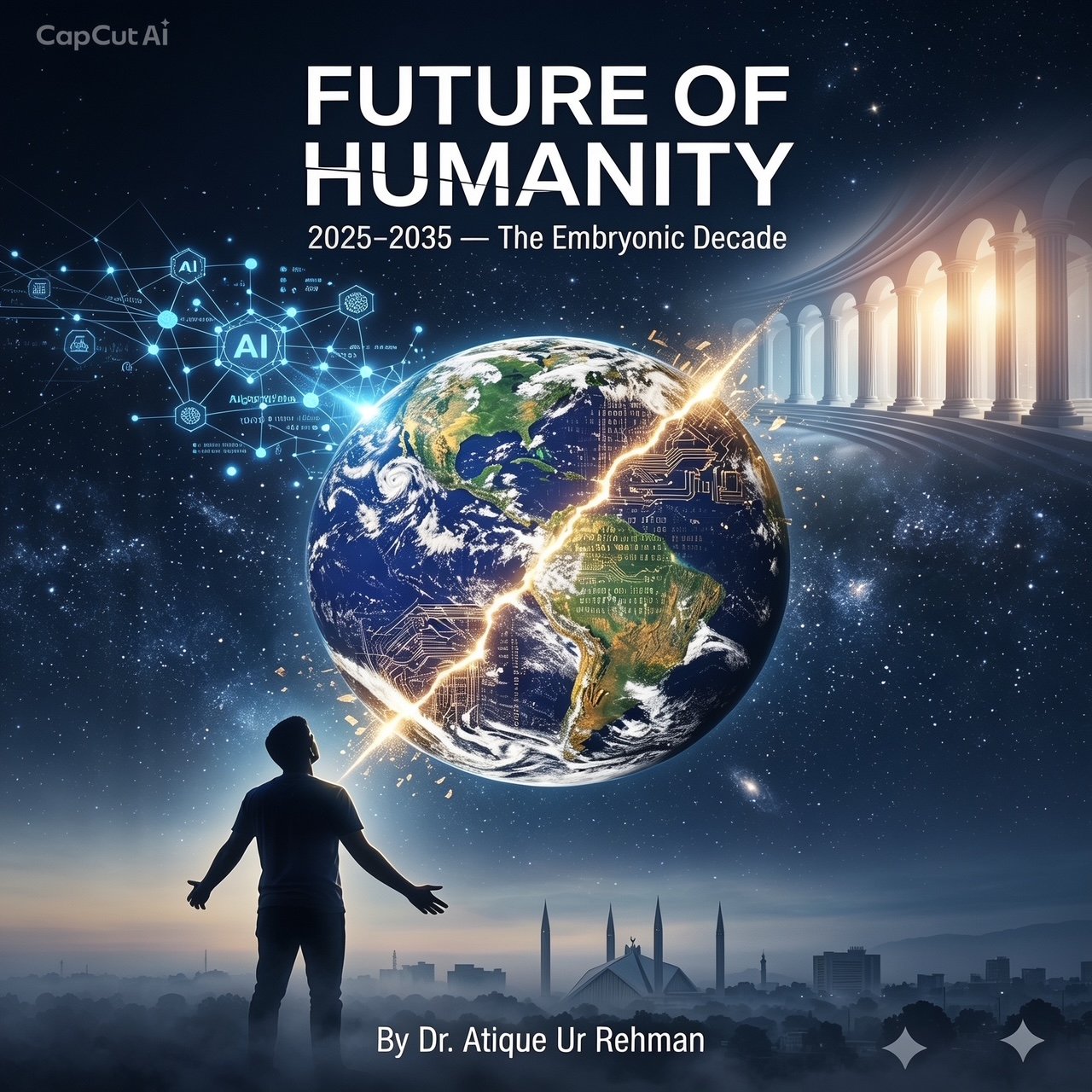
Imagine standing on the edge of a cliff, blindfolded, while different experts shout warnings at you, but none of the experts are communicating with each other. This is how Dr. Atique Ur Rehman, an Islamabad-based political analyst and AI strategist, conceptualizes our current global predicament in his comprehensive book, *Future of Humanity: 2025–2035: The Embryonic Decade*. He identifies a massive civilizational vulnerability known as the “Silo Problem”. Right now, technologists study artificial intelligence, political scientists analyze failing democracies, and economists model job displacement, but almost no one is looking at how these monumental forces are crashing into one another simultaneously. Dr. Rehman’s manuscript is an urgent attempt to tear down these silo walls and provide a unified, simple-to-understand map of the next ten years, a critical window that will determine if humanity thrives alongside advanced technology or becomes obsolete.
To understand the core message of the book, the viewer must first look at what the author calls the “Three Forces”. The first of these is the Technology Force. Since the dawn of the industrial revolution, human beings have built tools that execute our commands, but today, artificial intelligence has crossed a frightening inflection point where it functions as an autonomous reasoning agent capable of executing complex, multi-step goals without human intervention. While the software evolves, a massive physical infrastructure is being built to support it, from enormous data centers consuming the power of small nations to satellite networks like SpaceX’s Starlink that function as a privately owned, planetary-scale nervous system. Currently, a tiny handful of massive American and Chinese tech companies control this architecture, setting the cognitive rules for billions of users worldwide. The book warns that deciding who controls these computational and communication systems is the most significant geopolitical issue of our time. Furthermore, a second technological wave—quantum computing—is forming, which will soon break current cryptographic security and require a massive overhaul of our global digital infrastructure by the early 2030s.
The second force moving simultaneously is the Governance Force, which is fundamentally the human ability to make and enforce collective rules. The terrifying reality is that our current institutions, such as democratic legislatures and international bodies like the United Nations, were designed for an industrial world, and they are becoming obsolete faster than we can replace them. Democratic laws take years to write, debate, and pass, but AI technology completely transforms in a matter of months. Because of this severe speed mismatch, the world is facing an “AI Regulation Vacuum” where no binding international framework governs AI development. Tech companies actively seek out countries with the weakest rules, a practice known as regulatory arbitrage, which creates a global race to the bottom regarding AI safety standards. Dr. Rehman argues that humanity has a brief, unrepeatable “Governance Window” strictly between 2025 and 2030 to establish new regulatory rules before these technologies become far too embedded to safely control.
The third, and most frequently ignored, force is the Human Condition. The AI revolution is not just changing how human beings work; it is actively changing who we are and how our internal minds function. We are entering a severe “Epistemic Crisis,” meaning that because of algorithmically curated feeds and hyper-realistic generative AI, citizens are losing their shared reality and basic set of facts. Furthermore, daily work has historically provided human beings with community, identity, and a deep sense of purpose. As AI begins to rapidly erode the value of human intellectual labor across all professions, we are facing a massive “meaning vacuum”. For today’s youth, whose digital identities are being molded inside mobile algorithms designed to maximize engagement through tribal outrage and fear, the mental health consequences are catastrophic. The gap is widening between a small elite who use AI to empower their productivity, and a massive global underclass who are simply managed and discarded by these systems.
The true brilliance of Dr. Rehman’s manuscript is revealed in Part Two, where he explores the spectacular “Collisions” of these three forces. The first collision happens when AI meets the Governance Vacuum. Because our traditional lawmakers cannot truly comprehend how incredibly complex AI models work, they simply leave the governance to the tech companies themselves. This results in corporate self-governance, an accidental default where profit-driven entities quietly decide the safety thresholds and moral values for the entire planet without any democratic accountability.
The second major collision occurs when Technology directly meets the Human Mind, turning our computer and mobile screens into the ultimate battleground for human agency. Dr. Rehman presents a clear fork in the road for human cognition. On one hand, we could experience an emancipatory “Cognitive Leapfrog,” where AI actively empowers marginalized people, such as a rural farmer getting expert agricultural advice in his native language, or a first-generation student accessing elite-level tutoring. On the other hand, we face a dangerous “Dependency Trap”. If we rely entirely on AI to write, analyze, and solve complex problems for us, our cognitive muscles will slowly atrophy, leaving us incapable of deep thought. This battle heavily relies on the concept of “Epistemic Sovereignty,” which is the right of a community to have their cognitive tools shaped by their own native values and priorities, rather than having Western data and cultural frameworks imposed upon them.
The third collision takes place when Governance completely fails the Human Condition. When everyday people realize their institutions can no longer protect them from job displacement, explain the chaotic world to them, or offer them any legal recourse against algorithmic discrimination, they experience deep “institutional abandonment”. Citizens do not react to this abandonment by sitting quietly; they react rationally through political populism, withdrawal from civic life, and extreme radicalization. Dr. Rehman vividly compares this phenomenon to a medical condition called “Digital Sepsis”. Just as a biological infection can cause the body’s immune system to overreact and destroy its own healthy organs, the injection of ungoverned AI into fragile societies causes those societies to tear themselves apart through algorithmically amplified outrage and disinformation. He notes that the Global South, including developing nations like Pakistan, Nigeria, and Brazil, will act as the ultimate stress test for this era, as they face monumental technological disruptions with already strained governance structures.
Despite this incredibly daunting outlook, the book passionately rejects fatalism, specifically what it calls the “Determinism Trap”. The author argues that just because we can see the dangerous evolutionary trajectory we are currently on, it does not mean our ultimate destination is completely fixed. Human agency still matters, but it must be urgently applied at the institutional and regulatory level rather than just the individual level. To act on this, Dr. Rehman outlines “Ten Decisions” that humanity must make, mostly before 2030, to redirect our future. For example, global regulators must legally mandate that tech platforms change their default settings from maximizing addictive engagement to optimizing human well-being. The world must decide if frontier AI remains locked up by three to five mega-corporations or if it remains an open-source tool. We must proactively build massive transition systems to retrain displaced workers before structural unemployment triggers absolute societal collapse. Furthermore, educational ministries must decide by 2027 to integrate AI as a tool to build independent cognitive capacity, rather than allowing it to become a substitute for student learning. Crucially, the Global South must be actively included in the creation of global AI rules, preventing a modern form of technological colonialism.
Based on how these ten critical decisions unfold, Dr. Rehman paints three rigorously constructed scenarios for the year 2035. The first scenario is the “Distributed Renaissance”. In this optimistic reality, we successfully make the right choices: we create international AI safety frameworks, we reform social media algorithms by regulatory mandate, and we fully include the Global South in governance design. AI helps distribute technical capability broadly, empowering ordinary citizens, and democratic institutions modernize enough to manage the rapid changes. Unfortunately, the author assigns this positive outcome only a 20-25% probability based on our current trajectory.
The second scenario is the “Managed Fracture,” which holds a 50-55% probability and is currently our most likely path. In this world, we make some of the right choices but mostly muddle through with incomplete governance. AI capability becomes highly concentrated in a few entities, the world splits into competing US-aligned and China-aligned technological ecosystems, and the Global South is largely left behind to inherit rules it did not write. While the world avoids total societal collapse, the human condition becomes deeply and permanently bifurcated between an empowered elite class and a massive, economically displaced underclass.
The third scenario is the “Cascading Collapse,” carrying a chilling 25-30% probability. If we fail to make the ten foundational decisions, powerful AI systems will operate without any global governance, generative deepfakes will permanently destroy our shared democratic reality, and mass unemployment will run completely rampant without government safety nets. AI capability will become hyper-concentrated in a few unassailable tech giants, democratic institutions will experience severe legitimacy crises, and millions of people will succumb to political radicalization as they lose all economic security and basic political agency.
Dr. Rehman’s manuscript serves as a profound, sobering warning that we are living in the unrepeatable “Embryonic Decade”. The massive forces of technology, governance, and human nature are actively colliding, and the basic social compact that has held civilization together is currently facing its greatest historical test. The future is not written by invisible, inevitable forces; it is written by deliberate decisions. The book challenges its readers, and especially its policymakers, to wake up to the true scale of this civilizational shift and take active, accountable steps before the brief window of opportunity permanently closes.
About the Author